

Table of Contents
- Why Chronic Lower Back Pain Hits Women Over 40 Differently
- Hormonal Changes, Estrogen, and Lower Back Pain in Women Over 40
- Menopause and Lower Back Pain: What the Evidence Shows
- Reproductive Health Conditions That Refer Pain to the Lower Back
- Spinal Arthritis and Lower Back Pain: Spondylosis, Osteoarthritis, and Stenosis
- Disc Degeneration, Herniated Discs, and Age-Related Spinal Changes
- Muscle Strain, Posture, Pelvic Causes, and Other Non-Spinal Drivers
- Lower Back Pain Relief for Women Over 40: A Diagnostic and Treatment Pathway
- Frequently Asked Questions
Last Updated: October 16, 2026
Why Chronic Lower Back Pain Hits Women Over 40 Differently
Chronic lower back pain in women over 40 rarely has a single cause. It usually reflects hormonal shifts, age-related spinal changes, and reproductive health factors converging in midlife.
That matters because the standard advice, rest and generic stretching, misses the actual driver.
Below: each cause, the red flags that mean you should seek care quickly, and a practical diagnostic pathway that matches treatment to cause.
Hormonal Changes, Estrogen, and Lower Back Pain in Women Over 40
Estrogen receptors exist in spinal discs, cartilage, and bone, so shifting levels during perimenopause affect how these tissues hold up. Many clinicians note that women entering perimenopause report more musculoskeletal complaints, including lower back pain, though the evidence linking estrogen decline directly to pain is still developing, treat hormones as one contributing factor, not a complete answer. Falling estrogen is associated with faster bone loss and reduced disc hydration, both of which change how the spine absorbs load.
Menopause and Lower Back Pain: What the Evidence Shows
Menopause and lower back pain are connected, but the strength of that connection is often overstated online. After menopause, lower estrogen accelerates bone turnover and reduces disc water content, making the spine less resilient to daily strain; some research suggests postmenopausal women experience more frequent, more persistent back pain, though study quality varies. The honest takeaway: menopause is a risk factor, not a diagnosis.
Hormonal changes can raise your risk of chronic lower back pain, but they rarely explain it alone. Age-related spinal changes and reproductive conditions usually contribute too.
Reproductive Health Conditions That Refer Pain to the Lower Back
Several reproductive health conditions refer pain into the lower back, which is why gynecologic causes are easy to miss. Endometriosis, uterine fibroids, ovarian cysts, and pelvic inflammatory conditions can all produce a dull ache that reads as spinal pain. Endometriosis is the most common culprit: tissue similar to the uterine lining grows outside the uterus, and the resulting inflammation irritates nerves shared with the lower back, frequently causing cyclical back pain that worsens around the period.
When does cycle-related back pain need attention?
Pain that escalates over time, lasts beyond your period, or interferes with work and sleep is not “just cramps.” Persistent pelvic pain alongside back pain warrants evaluation for endometriosis or another reproductive condition.
Spinal Arthritis and Lower Back Pain: Spondylosis, Osteoarthritis, and Stenosis
Spinal arthritis is one of the most common causes of chronic lower back pain after 40, developing as the joints and discs of the spine wear down with age.
Three related conditions dominate:
- Spondylosis: general age-related degeneration of the spine
- Spinal osteoarthritis: wear of the facet joints that link vertebrae
- Spinal stenosis: narrowing of the spinal canal that presses on nerves
Spondylosis and osteoarthritis often produce stiffness and a dull ache that worsens with inactivity.
Degenerative spondylolisthesis, where one vertebra slips forward over another, can also narrow the canal and irritate nerves.
Disc Degeneration, Herniated Discs, and Age-Related Spinal Changes
Disc degeneration is a normal part of aging, but it does not always cause pain. Intervertebral discs lose hydration and height over time, a process called disc space narrowing; when that degeneration irritates surrounding nerves, pain follows. A herniated disc occurs when a disc’s soft inner material pushes through its outer layer and presses on a nerve root, often producing sharp, shooting pain down one leg, the hallmark of sciatica.
Muscle Strain, Posture, Pelvic Causes, and Other Non-Spinal Drivers
Not all chronic lower back pain starts in the spine. Muscle strain, posture problems, and pelvic conditions account for a large share of cases in women over 40, and several non-spinal sources are easy to miss because they refer pain into the back.
Muscular and postural drivers
Prolonged sitting and slouching weaken the muscles that keep the spine stable. When they fatigue, load shifts to discs and joints, and pain builds over months rather than days.
The tell for a muscular cause is usually mechanical: pain that worsens with a specific position or movement and eases when you change it, unlike nerve pain, which follows a predictable path down the leg regardless of position.
Pelvic and sacroiliac causes
Sacroiliac joint dysfunction, inflammation or abnormal movement where the pelvis meets the spine, produces low back pain that can mimic a disc problem, often as one-sided pain that worsens when you stand on one leg, climb stairs, or roll over in bed. Pregnancy and prior pelvic surgery raise the risk. Piriformis syndrome, in which a deep hip muscle compresses the sciatic nerve, causes similar nerve-type pain, and pelvic-floor dysfunction, common after childbirth and around menopause, can also refer pain into the lower back and sacrum.
Non-spinal sources beyond endometriosis
Reproductive conditions get most of the attention, but other systems can refer pain to the lower back:
Book your consultation today! →
- Urinary and kidney conditions. Kidney stones and urinary tract infections can cause flank or lower back pain, often with urinary symptoms, fever, or blood in the urine.
- Gastrointestinal conditions. Constipation, irritable bowel syndrome, and diverticular disease can produce lower back discomfort that tracks with bowel patterns.
- Pelvic-floor and gynecologic conditions. Beyond endometriosis, fibroids, ovarian cysts, and pelvic inflammatory conditions can all refer pain into the back.
Persistent or severe symptoms in any of these categories need clinical assessment, not self-treatment. A thorough exam separates these from spinal causes, and that distinction changes treatment entirely.
Red flags: when to seek urgent care
Most chronic lower back pain is not an emergency. But certain symptoms are. Seek emergency care immediately if you have:
- Loss of bladder or bowel control, or new difficulty urinating
- Saddle numbness, numbness or tingling in the groin, inner thighs, or the area that would touch a saddle
- New or worsening leg weakness, especially if it makes walking or standing difficult
- Fever or chills alongside back pain
Saddle numbness plus bladder or bowel changes can signal cauda equina syndrome, which needs immediate evaluation to prevent permanent nerve damage. Do not wait for a routine appointment if that pattern appears.
If back pain comes with loss of bladder or bowel control, saddle numbness, unexplained weight loss, or fever, seek emergency care immediately. These are red flags for serious conditions, not ordinary strain.
Muscle, posture, and pelvic causes are common and treatable, but they should be diagnosed by exam, not assumed. And any red-flag symptom overrides the rest of this guide: get evaluated the same day.
Lower Back Pain Relief for Women Over 40: A Diagnostic and Treatment Pathway
Lower back pain relief for women over 40 starts with an accurate diagnosis, not generic treatment. The biggest reason chronic pain persists past 12 weeks is that the original workup stopped at “back pain” instead of naming a source.
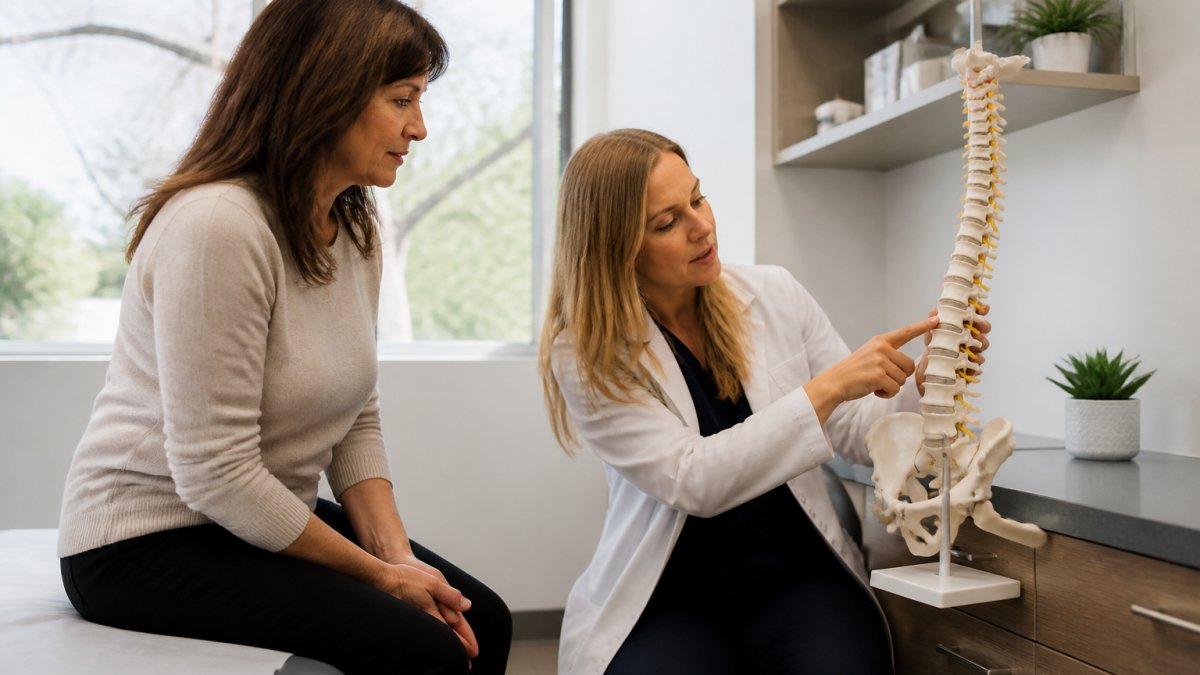
Step 1: History and pain mapping
Before any test, the history does most of the diagnostic work. Key questions:
- Timing. Did the pain start suddenly after a lift or fall, or did it build over months? Was it around the same time your periods became irregular?
- Pattern. Is it constant, or does it flare with sitting, standing, walking, or your cycle?
- Radiation. Does it stay in the back, or travel into the buttock, thigh, or below the knee? Pain that crosses the knee points toward a nerve root rather than a muscle.
- Cycle link. Does it worsen in the days before or during your period? That pattern raises the odds of a reproductive or pelvic contributor.
- Night pain and rest pain. Pain that wakes you or doesn’t ease with rest is a different signal than mechanical pain that improves when you lie down.
Women often arrive with a folder of imaging but no clear answers to these five questions, yet the answers narrow the cause before a single scan is ordered.
Step 2: Physical examination
A focused exam tests four things:
- Strength and reflexes. Weakness in the foot or ankle, or a reduced knee or ankle reflex, suggests nerve-root involvement.
- Sensation. Mapping numbness or tingling helps localize which nerve is irritated.
- Joint mobility. Restricted, painful motion at the facet joints or the sacroiliac joint points to an arthritic or pelvic source rather than a disc.
- Provocation tests. Specific maneuvers, straight-leg raise, seated slump, sacroiliac compression and distraction, reproduce pain from a particular structure. These are the tests that separate a disc from a joint from a pelvic cause.
Step 3: Targeted imaging
Imaging is a tool, not a verdict:
- X-ray is reasonable when fracture, significant arthritis, or spinal alignment is the question.
- MRI is appropriate when the exam points to a nerve root, when symptoms are progressive, or when surgery or an injection is being considered.
- Imaging without a matching exam question often creates confusion rather than clarity. Many women over 40 have disc degeneration or facet arthritis visible on an MRI with no pain at all. A scan that shows wear does not prove the wear is the source.
If a provider orders imaging before examining you, it’s reasonable to question that.
Step 4: Cause-matched treatment
Treatment should follow the source, not the symptom. The table below maps common patterns to first-line approaches.
| Cause | Typical Pattern | First-Line Approach |
|---|---|---|
| Muscle strain / posture | Dull ache, worse with sitting | Core strengthening, ergonomics, graded activity |
| Disc degeneration | Stiffness, episodic flare-ups | Physical therapy, activity pacing, anti-inflammatory medication as needed |
| Herniated disc / sciatica | Shooting leg pain below the knee | Targeted physical therapy, nerve-focused care, medication; injection or surgical evaluation if symptoms progress |
| Spinal arthritis / stenosis | Stiffness, leg symptoms when walking | Mobility work, joint-focused treatment, walking-distance pacing |
| Sacroiliac joint dysfunction | Pain low in the back, one-sided, worse with standing on one leg | Pelvic stabilization, physical therapy, targeted injection in some cases |
| Reproductive / pelvic | Cyclical or pelvic-linked ache | Gynecologic evaluation plus pelvic-floor physical therapy |
Two safety notes for midlife patients. First, medication choices deserve a second look after 40: long-term NSAID use carries gastrointestinal and cardiovascular risks that rise with age, and some muscle relaxants cause daytime drowsiness that raises fall risk. Second, opioids for chronic non-cancer back pain should be a short, monitored exception, not a default.
Step 5: Reassessment
If a plan isn’t working within six to eight weeks of consistent effort, revisit the diagnosis, not just the treatment. Escalating the same failing therapy rarely changes the outcome; re-examining the source often does.
This is where a root-cause approach matters. Advanced Health Center has helped over 10,000 patients and managed complex cases for more than 40 years, focusing on non-surgical, drug-free care for chronic pain.
Frequently Asked Questions
Can menopause cause lower back pain?
Menopause can contribute to lower back pain, but it is rarely the sole cause. Falling estrogen levels affect bone density, joint lubrication, and muscle support, which can make the spine more vulnerable to strain and osteoarthritis. Many women in perimenopause and menopause also sleep poorly and move less, which adds to stiffness. If your pain is persistent, getting evaluated helps separate hormonal contributors from structural ones like disc degeneration or spinal arthritis.
Does hormonal imbalance cause lower back pain?
Hormonal shifts can influence lower back pain in women over 40, especially around perimenopause when estrogen fluctuates. Estrogen supports bone remodeling and joint health, so when levels drop, the spine and surrounding structures may lose some resilience. That said, hormonal imbalance is usually one piece of a larger picture that includes muscle strain, disc changes, and reproductive conditions. A proper exam can help identify which factors are driving your pain.
When should women over 40 see a doctor for lower back pain?
See a doctor if your lower back pain lasts more than a few weeks, interferes with sleep or daily activities, or comes with numbness, tingling, or weakness in your legs. Seek urgent care for loss of bladder or bowel control, sudden severe pain after a fall, unexplained weight loss, or fever. Women over 40 with a history of cancer, osteoporosis, or long-term steroid use should be evaluated sooner rather than later.
What helps relieve chronic lower back pain in women over 40?
Relief usually combines several approaches: staying active with low-impact exercise like walking or swimming, targeted physical therapy to strengthen supporting muscles, and treatments that address the underlying cause rather than just the symptom. For women over 40, hormone-related changes, spinal arthritis, and disc degeneration often need different strategies. A provider can match treatment to your specific diagnosis, which is why an accurate evaluation matters before choosing a path.