

Last Updated: October 29, 2026
Quick Summary
The most effective ergonomic tips for seniors focus on small changes to chair setup, screen position, sleep posture, and daily chores. Adjusting seat height, placing screens at arm’s length, and using lumbar support can ease the repetitive strain that builds into daily aches.
- Set your seat so your feet rest flat and knees sit level with or below your hips.
- Place a small cushion or rolled towel at the curve of your lower back for support.
- Position your screen about an arm’s length away, with the top at or just below eye level.
- Sleep with a pillow between your knees if you side sleep to keep hips and lower back aligned.
- Change activities every 20 to 30 minutes to give your joints time to recover.
Table of Contents
- Why Daily Aches Build Up in Older Adults
- Ergonomic Chair Setup for Back Pain
- Sleeping Positions That Ease Joint Pain
- Home Fall Prevention for Seniors
- Joint-Friendly Household Chores
- Gentle Stretches for Seniors to Do Daily
- Booking a Posture and Pain Assessment at Advanced Health Center
- Frequently Asked Questions
Daily aches in seniors rarely come from one dramatic event. They build up slowly, from the chair you sit in, the screen you stare at, and the way you sleep. Small changes can ease that buildup, and the most helpful of these ergonomic tips are often simpler than people expect. Many active adults first want to know what they can change at home before trying anything else. This guide walks through seven practical ergonomic tips you can start today.
Why Daily Aches Build Up in Older Adults
Aches usually come from repetition, not from one big strain. The same posture held for hours, the same reach made every morning, and the same bed position night after night all add up.
As we age, muscles and joints lose some flexibility and recover more slowly. That makes poor positioning harder to shake off.
- Sitting in one position for long stretches
- Reaching or twisting the same way during chores
- Sleeping in a posture that strains the neck or hips
- Stiffness that makes the next movement feel worse
Ergonomic Chair Setup for Back Pain
A good chair is the easiest place to start. To understand what is behind that discomfort, read why your back hurts when sitting all day. Most back aches during the day come from slumping over the seat.
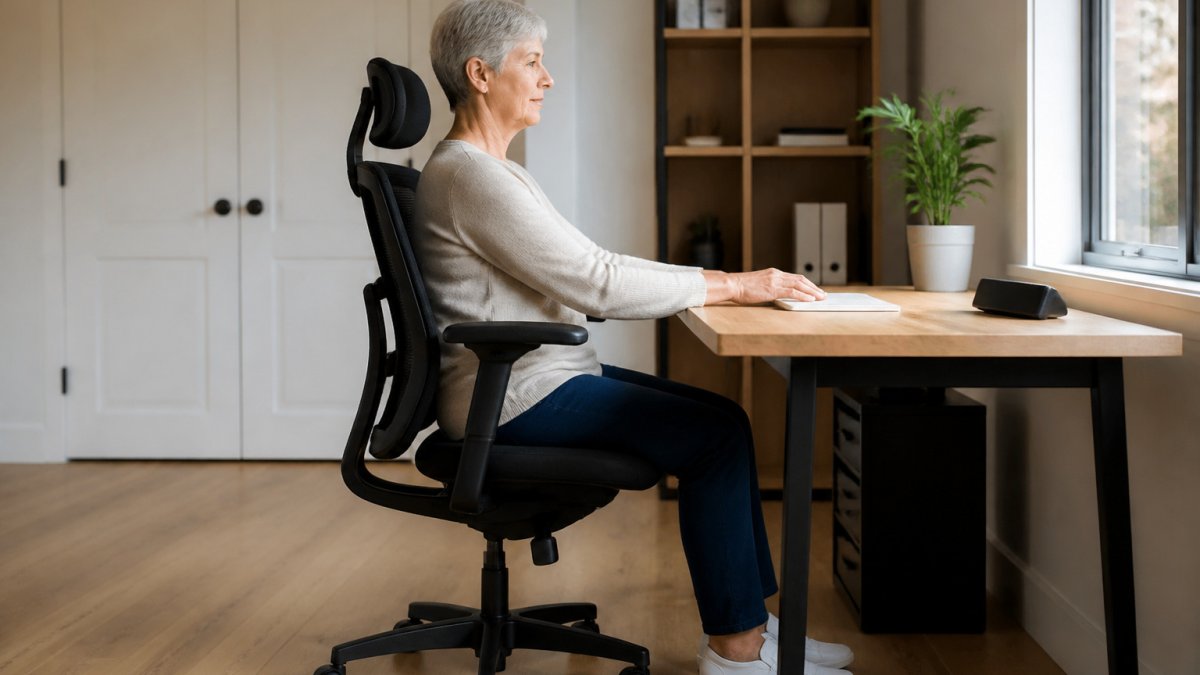
Setting Seat Height and Lumbar Support
Set the seat so your feet rest flat on the floor, with knees level with or slightly below your hips. If your feet dangle, use a footrest.
Next, add lumbar support. A small cushion or rolled towel placed at the curve of your lower back keeps your spine upright without effort. Sit all the way back in the chair so the support actually meets your back. Maintaining this neutral spinal alignment also helps to fix tech neck when you transition from your chair to handheld devices.
Positioning Screens and Keyboards
Place your screen about an arm’s length away, with the top of the screen at or just below eye level. This keeps your neck from tilting down for hours.
Keep your keyboard close enough that your elbows stay near your sides, bent at roughly a right angle. For more guidance, see how to improve posture while working from home. Reaching forward to type is one of the most common causes of shoulder and neck tension.
The article’s chair and screen setup points can be scanned at a glance, so here is a quick reference.
| Setup item | Target position | Why it matters |
|---|---|---|
| Seat height | Feet flat, knees level with or below hips | Prevents strain on the lower back |
| Lumbar support | Small cushion or rolled towel at lower back | Keeps the spine upright |
| Screen distance | About an arm’s length away | Avoids neck tilting down for hours |
| Screen top | At or just below eye level | Reduces neck tension |
| Keyboard elbows | Bent at roughly a right angle, close to sides | Limits shoulder and neck tension |
Sleeping Positions That Ease Joint Pain
Many people wake up stiff because of how they slept, not because of anything they did that day. A few small changes can make mornings noticeably easier.
- Side sleeping: Place a pillow between your knees to keep your hips and lower back aligned.
- Back sleeping: Put a pillow under your knees to ease pressure on the lower back.
- Neck support: Use a pillow that keeps your head level with your spine, not tilted up or down.
- Avoid stomach sleeping if you have neck or lower back pain, since it twists the spine.
Mattress firmness also matters. Many people find a medium-firm surface gives the most even support, though comfort varies from person to person.
Book your consultation today! →
Home Fall Prevention for Seniors
Falls cause a large share of injuries in older adults, and they often start with a simple trip. Clearing your home of hazards protects your joints as well as your balance.
- Remove loose rugs or secure them with non-slip backing
- Keep walkways clear of cords, boxes, and clutter
- Add grab bars in the shower and beside the toilet
- Use night lights in hallways and bathrooms
- Store everyday items between shoulder and knee height
A fall can turn an ache into a serious injury, so these changes are worth making early.
Joint-Friendly Household Chores
Chores can strain the same joints every day if you do them the same way. Small adjustments reduce the load.
- Vacuuming: Push with your body weight instead of your arms.
- Carrying groceries: Split loads into smaller bags and carry them close to your body.
- Cooking: Use a stool for longer tasks and keep frequently used items within easy reach.
- Laundry: Use a basket on wheels to avoid lifting heavy loads.
Take short breaks between tasks. Changing activity every 20 to 30 minutes gives your joints a chance to recover.
Gentle Stretches for Seniors to Do Daily
Gentle movement keeps joints mobile and muscles from tightening. Do these slowly, and stop if you feel sharp pain.
- Neck turns: Slowly turn your head left, then right. Hold each side for 5 seconds.
- Shoulder rolls: Roll both shoulders backward ten times, then forward ten times.
- Seated hamstring stretch: Extend one leg straight with the heel on the floor and gently lean forward. Hold for 15 to 20 seconds.
- Cat-cow stretch: While seated or on the floor, slowly arch and round your back. Repeat five to ten times.
Try to do these once or twice daily, especially after long periods of sitting. If you have an existing condition, check with your doctor before starting a new routine.
Booking a Posture and Pain Assessment at Advanced Health Center
If daily aches continue despite these changes, a professional assessment can show what is driving them. You can also learn about regenerative knee therapy for seniors before booking. Advanced Health Center offers non-surgical, drug-free pain relief for chronic back, neck, and joint pain. The clinic has over 40 years of experience managing auto injury cases.
Pricing depends on your individual needs, so visit our website for current details or to request a quote. Book your consultation today to find out how personalized care can help you move with less pain.
Frequently Asked Questions
What ergonomic changes can help seniors prevent daily aches?
The most effective ergonomic changes are the ones you make to the places you spend the most time. Set your chair so your feet rest flat on the floor and your knees sit level with or slightly below your hips. Add lumbar support behind your lower back, and position your screen at eye level so you are not craning your neck. Keep frequently used items within easy reach to avoid twisting or overstretching. Small adjustments like these reduce repeated strain on the back, neck and shoulders, which is where many daily aches begin. Start with one change, notice how your body responds over a week, and then add the next.
How should seniors sit to reduce back and neck pain?
Sit with your back supported against the chair, shoulders relaxed, and head stacked over your spine rather than pushed forward. Keep elbows bent near 90 degrees with forearms supported, and avoid crossing your legs for long periods. Ergonomic chair setup for back pain works best when you also change position regularly. Stand up, walk briefly, or shift your weight every 30 to 45 minutes. If sitting still for an hour leaves you stiff, your setup may be right but your breaks may need to be more frequent.
What is the best sleeping position for older adults with joint pain?
Many people with joint pain sleep more comfortably on their side with a pillow between the knees, which keeps the hips and lower back aligned. Back sleeping can work well with a pillow under the knees to ease pressure on the lower back. Stomach sleeping often strains the neck and lower back and is usually the least comfortable choice. A supportive mattress and a pillow that keeps your head level with your spine matter as much as position. If a position consistently leaves you waking with stiffness, try changing one variable at a time and track what helps.
When should a senior see a doctor about persistent aches?
See a doctor if aches last more than a few weeks, worsen despite rest and posture changes, or interfere with sleep or daily activities. Seek care promptly for sudden severe pain, numbness or weakness in a limb, pain after a fall, or new confusion or chest discomfort, which can signal an emergency. Persistent pain that affects walking, balance or independence deserves a professional evaluation. A clinician can identify whether the cause is muscular, joint-related or nerve-related, which determines the most appropriate treatment plan.
