

Last Updated: October 31, 2026
Quick Summary
Core stability exercises for spinal health train the muscles around your trunk to hold your spine steady, which reduces strain during everyday tasks like lifting or sitting. A simple routine starts with the abdominal brace, then adds bird dogs, dead bugs, bridges and side planks, practiced three to five days per week.
- Start with the abdominal brace: hold for 10 seconds and repeat 5 times.
- Do bird dogs and dead bugs for 8 to 10 reps per side to build a stable foundation.
- Progress to bridges and side planks once your form stays clean.
- Practice 10 to 15 minutes per session, three to five days per week.
- Talk with your doctor first if you have a recent injury or pain spreading down a leg.
Table of Contents
- Why Core Stability Matters for Your Spine
- What You’ll Need Before You Start
- Step 1: Learn the Abdominal Brace
- Step 2: Build the Foundation With Bird Dogs and Dead Bugs
- Step 3: Progress to Bridges and Side Planks
- How Often to Do Core Stability Exercises
- Booking a Spine-Focused Assessment in San Jose
- Frequently Asked Questions
Why Core Stability Matters for Your Spine
Core stability exercises for spinal health train the muscles that wrap around your trunk to hold your spine steady. When those muscles work well, your back gets less strain during everyday tasks like lifting groceries or sitting at a desk. Building this foundational support becomes even more critical when you need to strengthen core for lifting heavier loads safely.
Many people with back pain find that weak deep muscles play a role in their symptoms (the NIH). Strengthening them is a common, low-risk starting point, though it works best alongside guidance from your care team.
- Less strain on the discs and joints in your lower back
- Better posture during long sitting or standing
- Improved balance and control when you move
- A foundation for more advanced movement and sport
A National Institutes of Health overview of low back pain treatment explains why active exercise is commonly recommended for ongoing back pain. Keep your expectations realistic: steady practice over weeks builds results.
For a broader set of exercises beyond core work, see strengthen your lower back and reduce pain.
What You’ll Need Before You Start
You need very little equipment to begin. A firm mat or carpeted floor is enough for most of these core stability exercises for spinal health.
- A yoga mat or folded towel for knee support
- Comfortable clothes that let you move freely
- A timer or phone to track your holds
- A wall or sturdy chair for balance support
Talk with your doctor first if you have a recent injury, a spinal condition, or pain that spreads down a leg. Stop any movement that causes sharp pain.
Step 1: Learn the Abdominal Brace
The abdominal brace is the base skill for every exercise that follows. It teaches your deep core muscles to tighten before you move.
Lie on your back with knees bent and feet flat. Breathe in gently, then tighten your belly as if you were bracing for a light poke. Keep breathing while you hold.
- Hold the brace for 10 seconds
- Repeat 5 times
- Practice once or twice daily
Watch out: Holding your breath or squeezing your glutes too hard can raise your blood pressure and tire you out. Keep the brace calm and steady.
Step 2: Build the Foundation With Bird Dogs and Dead Bugs
These two moves teach you to keep your spine still while your arms and legs move. That stability is the heart of core stability work.
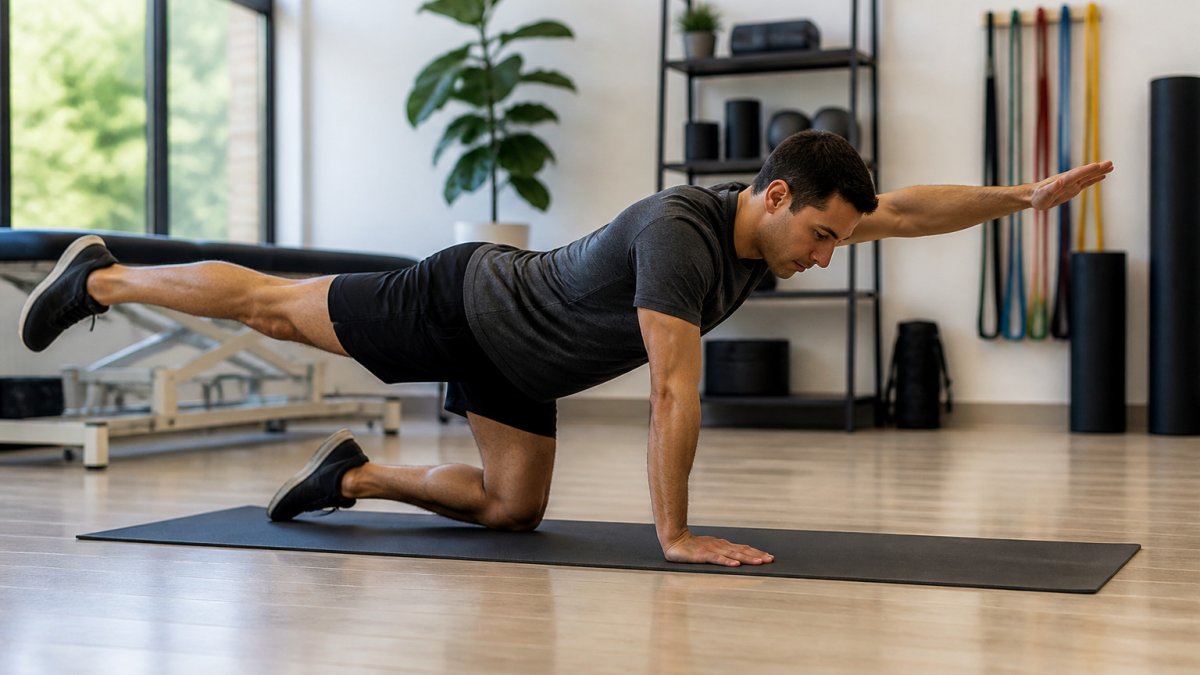
For the bird dog, start on hands and knees with your back flat. Extend one arm forward and the opposite leg back, hold for 3 seconds, then switch sides. For the dead bug, lie on your back with arms reaching up and knees bent over your hips, then slowly extend one arm and the opposite leg toward the floor.
Book your consultation today! →
- Complete 8 to 10 reps per side
- Move slowly and keep your lower back quiet
- Stop if you feel pain that does not ease
!Adult in workout clothes performing a bird dog exercise on a yoga mat in a bright clinic room, hands and knees aligned, focused expression
Step 3: Progress to Bridges and Side Planks
Once the foundation feels steady, add load and challenge. Bridges work your glutes and deep core together, while side planks train the muscles along your sides.
For a bridge, lie on your back with knees bent, then lift your hips until your body forms a straight line from shoulders to knees. Hold for 5 seconds and lower slowly. For a side plank, prop yourself on one forearm with knees bent, lift your hips, and hold for 10 to 20 seconds per side.
- Start with 2 sets of 8 bridges
- Begin side planks on your knees before trying full ones
- Add time to holds only when the form stays clean
How Often to Do Core Stability Exercises
Most people benefit from practicing these movements 3 to 5 days per week. Short, consistent sessions of 10 to 15 minutes work better than rare, long workouts.
A American College of Sports Medicine exercise guidelines recommends regular activity spread across the week, which fits this schedule well. Rest a day if your back feels sore the next morning.
Here is a quick summary of the practice schedule and the key exercise steps covered in this article.
| Exercise | Reps or time | Frequency |
|---|---|---|
| Abdominal brace | 10-second hold, 5 times | Once or twice daily |
| Bird dog and dead bug | 8 to 10 reps per side | Part of routine |
| Bridge | 2 sets of 8 | Part of routine |
| Side plank | 10 to 20 seconds per side | Add time when form stays clean |
| Overall practice | 10 to 15 minutes per session | 3 to 5 days per week |
Booking a Spine-Focused Assessment in San Jose
If your back pain persists despite steady practice, a professional assessment can help identify the cause. If you want to learn more about the options available, you can explore the care information on our website before deciding on treatment. Read whether spinal decompression therapy is worth it for back pain to weigh that option.
When you are ready to explore options, book a consultation for pain relief in San Jose to discuss your symptoms with the team. For current prices or a quote, please visit our website or contact the clinic directly.
Frequently Asked Questions
What are the best core stability exercises for spinal health?
The most useful starting points are the abdominal brace, bird dogs, dead bugs, bridges and side planks. Each one trains the deep trunk muscles that help hold the spine steady during everyday movement. Start with the simplest version you can perform with clean form, hold each position for a few breaths, and add repetitions or difficulty only when the movement feels controlled. If pain increases during or after a session, stop and have a clinician review your approach before continuing.
Can core exercises help with lower back pain?
Core exercises can help many people with lower back pain because stronger, better-coordinated trunk muscles can reduce strain on the lumbar spine during lifting, sitting and walking. Gentle, controlled movements such as bird dogs and bridges are common starting points. Results vary by cause and severity, so a professional evaluation is the right first step for persistent or worsening pain. For guidance on your specific condition, you can learn more about Advanced Health Center in San Jose on our website.
How often should I do core stability exercises?
Most beginners do core stability work three to five days per week, with short sessions of 10 to 20 minutes. Consistency matters more than intensity in the early weeks. Rest days allow tissues to recover, and you should notice steadier posture and easier movement over several weeks. If soreness lasts more than a day or two, reduce the number of repetitions or the difficulty and build back up gradually.
How do I know if I am doing a core exercise correctly?
Good form is controlled, steady and pain-free. Keep your breathing smooth, avoid arching or sagging through the lower back, and move only through a range you can manage. A mirror, a video of yourself or a clinician’s feedback can reveal compensations such as holding your breath or shifting into the hips. If you cannot maintain form for the full set, choose an easier variation rather than pushing through.
Core stability work is a practical step toward a stronger, more comfortable spine. Start with the abdominal brace, build with bird dogs and dead bugs, and progress as your control improves.
