

Table of Contents
- Why Strengthening Your Lower Back Matters for Pain Relief
- Signs of a Weak Lower Back You Shouldn’t Ignore
- What You’ll Need Before Starting
- 7 Exercises to Strengthen Your Lower Back
- 1. Pelvic Tilts for Core Stabilization
- 2. Bridge Exercises for Gluteus Maximus Activation
- 3. Bird-Dog for Spinal Stability
- 4. Cat-Camel Stretches for Flexibility
- 5. Knee-to-Chest Stretches for Lower Lumbar Relief
- 6. Prone Leg Lifts for Erector Spinae Strength
- 7. Dead Bug for Deep Core Muscle Activation
- How Long to See Results From Back Strengthening
- Best Practices for Back Pain Prevention
- Common Mistakes to Avoid When Strengthening Your Back
- When to Seek Professional Help
- Frequently Asked Questions
Last Updated: September 25, 2026
Why Strengthening Your Lower Back Matters for Pain Relief
Lower back pain affects millions of people, limiting work, exercise, and daily life. The good news: you can strengthen lower back muscles and reduce pain without surgery or drugs.
Strengthening your core and lower back muscles addresses the root cause of pain, not just the symptoms.
A weak lower back creates a cascade of problems: your spine lacks support, discs compress, and nerves get irritated. Building strength in your core stabilization muscles restores proper spinal alignment and reduces inflammation naturally.
Signs of a Weak Lower Back You Shouldn’t Ignore
Not sure if your lower back needs strengthening? Watch for these warning signs.
Pain that worsens after sitting or standing signals weak core muscles; your stabilizer muscles fatigue quickly, forcing your spine to work harder.
Difficulty bending or twisting indicates reduced range of motion from weak erector spinae and deep core muscles, causing compensatory movement patterns that create more pain.
Chronic pain that persists despite rest signals you need active strengthening to rebuild the muscular support your spine depends on.
Poor posture is both a cause and a symptom. Weak abdominal muscles can’t support your lumbar spine, so you slouch. Slouching weakens muscles further. Breaking this cycle requires deliberate strengthening work. Consistent attention to correcting poor posture serves as the essential foundation for lasting spinal health and long-term relief.
What You’ll Need Before Starting
You need a yoga mat or folded towel, a quiet space, comfortable clothing, and 15-20 minutes three times per week. Optional items include a pillow, resistance band, and mirror. Start with basic versions, focusing on proper form over speed or intensity.
7 Exercises to Strengthen Your Lower Back
These seven exercises strengthen lower back muscles that stabilize your lumbar spine, addressing pelvic tilt, core stabilization, and spinal alignment. Perform them three times per week with at least one rest day between sessions for muscle recovery and adaptation.
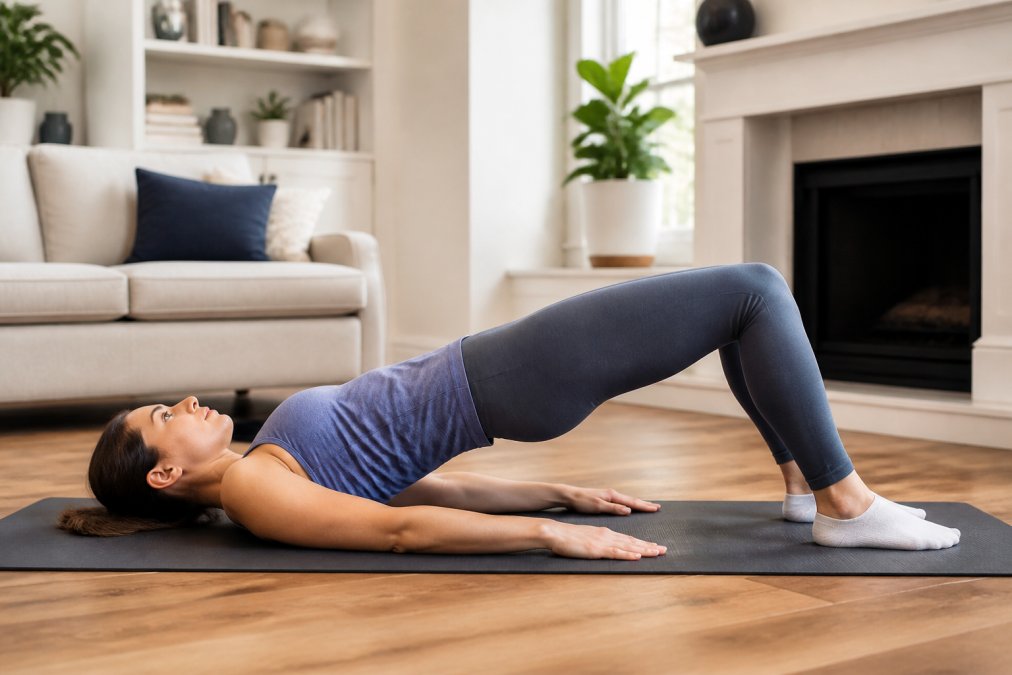
1. Pelvic Tilts for Core Stabilization
Pelvic tilts teach proper neutral spine positioning and activate deep core muscles. Lie on your back with knees bent, feet hip-width apart. Tilt your pelvis to flatten your lower back against the floor, hold two seconds, then relax. Perform two sets of ten repetitions with slow, controlled movements.
Pelvic tilts feel easy because they’re low-intensity. That’s the point. They reprogram your body’s sense of neutral spine. Do them daily, even on rest days from other exercises.
2. Bridge Exercises for Gluteus Maximus Activation
Bridges activate your glutes and strengthen your lower back. Lie on your back with knees bent, feet hip-width apart. Press through heels and lift hips to form a straight line from knees to shoulders. Hold two seconds, squeeze glutes, lower slowly. Perform three sets of twelve repetitions. If your lower back cramps, you’re using it instead of your glutes, reset and focus on the glute squeeze.
Never arch your lower back at the top of the bridge. Your pelvis should stay neutral. Arching defeats the purpose and stresses your lumbar spine.
3. Bird-Dog for Spinal Stability
The bird-dog exercise builds proprioception and activates your transverse abdominis. Start on hands and knees. Extend your right arm forward while extending your left leg backward, keeping your spine neutral. Hold two seconds, return to start, repeat on the other side. Perform three sets of ten repetitions per side with focus on proper form.
4. Cat-Camel Stretches for Flexibility
Cat-camel stretches improve flexibility and mobilize your lumbar spine. Start on hands and knees. Round your spine, drawing your belly button toward your spine and tucking your chin (cat position), hold two seconds. Then arch your lower back gently while lifting your gaze (camel position), hold two seconds. Move slowly between positions for two minutes daily, preferably in the morning.
Cat-camel stretches should feel good, not painful. If you feel sharp pain, stop immediately and consult a healthcare provider.
5. Knee-to-Chest Stretches for Lower Lumbar Relief
Knee-to-chest stretches target your lower lumbar spine and gluteal muscles. They release tension that builds from sitting and poor posture.
Lie on your back with both knees bent and feet flat on the floor. Pull one knee toward your chest. Keep your other foot on the floor.
Hold the stretch for thirty seconds. You should feel a gentle stretch in your lower back and glute. Return to starting position and repeat on the other side.
Perform three repetitions per side. Do this stretch daily, especially after sitting for long periods.
This simple stretch counters the compression that happens during desk work. It’s one of the most effective ways to reduce lower lumbar pain caused by prolonged sitting.
6. Prone Leg Lifts for Erector Spinae Strength
Prone leg lifts strengthen your erector spinae, the muscles that run along both sides of your spine. These muscles are essential for upright posture and spinal stability.
Lie face down on your mat. Place your arms at your sides or folded under your forehead for comfort.
Lift one leg about six inches off the ground. Keep your pelvis flat against the mat. Hold for two seconds.
Lower your leg slowly and repeat on the other side. Perform three sets of twelve repetitions per leg.
Book your consultation today! →
The movement should be small and controlled. You’re not trying to kick your leg high. You’re building endurance in the muscles that support your spine.
Many people feel lower back strain during this exercise. If you do, you’re lifting too high or moving too fast. Lower your expectations and focus on perfect form.
7. Dead Bug for Deep Core Muscle Activation
The dead bug exercise activates your deep core muscles while keeping your lower back safe. It builds strength through controlled movement.
Lie on your back with your knees bent and feet flat on the floor. Lift your feet off the ground so your knees are at ninety degrees. Your hips should also be at ninety degrees.
Extend your right arm overhead while straightening your left leg. Your right arm and left leg should hover just above the floor. Return to starting position.
Repeat on the other side. This is one repetition. Perform three sets of ten repetitions per side.
Keep your lower back pressed against the floor throughout the movement. If your lower back arches away from the floor, you’re moving too far. Reduce your range of motion.
This exercise looks simple but demands precision. Your core must stabilize your spine while your limbs move. That’s exactly what your core needs to learn.
How Long to See Results From Back Strengthening
Most people see noticeable improvement within three to four weeks of consistent exercise. This is when your nervous system adapts and your muscles begin to respond.
Real structural changes take longer. Building muscle endurance and strength requires eight to twelve weeks of consistent work. Patience matters here.
Some people feel relief immediately after their first session. This is usually decreased muscle tension, not lasting improvement. Sustained relief comes from building actual strength.
Track your progress by noting what movements hurt. Can you sit longer without pain? Bend further without stiffness? These small wins accumulate into major improvement.
Consistency beats intensity. Three sessions per week of proper form outperforms sporadic intense sessions. Your muscles adapt to regular stimulus, not occasional effort.
Best Practices for Back Pain Prevention
Once you’ve built strength, maintaining it prevents pain from returning. Prevention is easier than recovery.
Ergonomic Adjustments for Daily Life
Your workspace either supports your lower back or stresses it. Most office setups do the latter.
Your monitor should sit at eye level. Your elbows should rest at ninety degrees when typing. Your feet should sit flat on the floor or footrest.
A proper chair supports your lumbar curve. Avoid slouching.
Post-Exercise Recovery and Rest Days
Rest days aren’t optional. They’re when your muscles adapt and strengthen. Without adequate recovery, you create fatigue and injury risk.
Common Mistakes to Avoid When Strengthening Your Back
Most people fail not from lack of effort but from preventable mistakes.
When to Seek Professional Help
These exercises help most people with lower back pain. Some situations require professional evaluation.
Frequently Asked Questions
What are the signs of a weak lower back?
A weak lower back often shows itself through persistent pain in the lumbar spine, difficulty standing or sitting for long periods, and reduced range of motion. You may experience muscle tension that feels constant, struggle with everyday activities like bending or lifting, or notice your posture deteriorating by the end of the day. Chronic pain that worsens with activity is another key indicator. If these symptoms persist for more than a few weeks, professional evaluation is important to rule out serious conditions.
How long does it take to see results from strengthening exercises?
Most people notice initial improvements in flexibility and reduced muscle tension within 2-3 weeks of consistent exercise. Measurable strength gains and meaningful pain reduction typically appear after 4-6 weeks of regular practice. However, results vary based on the severity of your condition, exercise consistency, and whether you’re addressing underlying ergonomic issues. Chronic pain that’s been present for years may require 8-12 weeks of dedicated work. The key is steady, controlled movement rather than intensity.
What’s the best way to prevent lower back pain?
Prevention centers on three pillars: maintaining core strength through regular exercises, using proper body mechanics during daily activities, and making ergonomic adjustments to your workspace and home. Strengthen your deep core muscles and transverse abdominis to support your lumbar spine. Maintain neutral spine alignment when sitting, standing, and lifting. Take regular breaks from prolonged sitting, stay active, and address muscle tension through stretching. Managing stress and maintaining a healthy weight also reduce strain on your lower back.
Can I strengthen my lower back at home without equipment?
Yes. All seven exercises outlined in this guide require no equipment beyond a yoga mat or towel. Bodyweight exercises like pelvic tilts, bridges, bird-dogs, and dead bugs are highly effective for building core stabilization and spinal alignment. These controlled movements activate your gluteus maximus, erector spinae, and deep core muscles without expensive equipment. Consistency matters more than fancy tools. Start with 2-3 sessions per week and progress gradually as your strength improves.