

Table of Contents
- Why Limited Movement Persists When You Only Treat Symptoms
- Step-by-Step Plan: How to Regain Lost Mobility at Home
- Exercises to Improve Mobility Without Aggravating Pain
- Physical Therapy for Mobility: What to Expect and When It Helps
- When Limited Mobility Needs Medical Evaluation
- Measuring Progress: How to Know You’re Actually Regaining Mobility
- Preventing Relapse: How to Keep Mobility Long-Term
- Conclusion: Your Next Step Toward Lasting Mobility
- Frequently Asked Questions
Last Updated: October 4, 2026
Why Limited Movement Persists When You Only Treat Symptoms
Most people chase pain relief and never fix what’s causing it. At Advanced Health Center, we’ve watched this cycle repeat for decades: a cortisone shot quiets the knee, a massage loosens the back, and three weeks later the stiffness is back.
Pain is a signal, not the source. Masking it with medication or a single adjustment leaves the underlying issue untouched, so relief lasts only as long as the treatment does.
The fix starts with understanding two very different problems.
Muscular Causes vs. Joint Dysfunction: What’s Actually Restricting You
Muscular causes are problems in the soft tissue: tight muscles, weak stabilizers, scar tissue, and poor movement patterns. Joint dysfunction is a mechanical problem inside the joint itself, where the surfaces don’t glide or track the way they should.
The two often overlap, which is why a single fix rarely works: a stiff hip joint forces nearby muscles to compensate, and over time those muscles tighten and weaken.
Treatment differs: soft-tissue work and strengthening help muscular causes, while joint mobilization, chiropractic adjustment, and targeted therapy help joint dysfunction. Guess wrong and you waste months.
How to Identify the Cause of Your Restricted Movement
Start with a simple self-check. It won’t replace an exam, but it points you in the right direction.
- Morning stiffness that eases with movement: often joint-related
- Pain that worsens with activity: often muscular or inflammatory
- A hard stop in range of motion: suggests joint dysfunction
If you’re unsure, a proper exam with a qualified provider is the fastest way to find the root cause.
Step-by-Step Plan: How to Regain Lost Mobility at Home
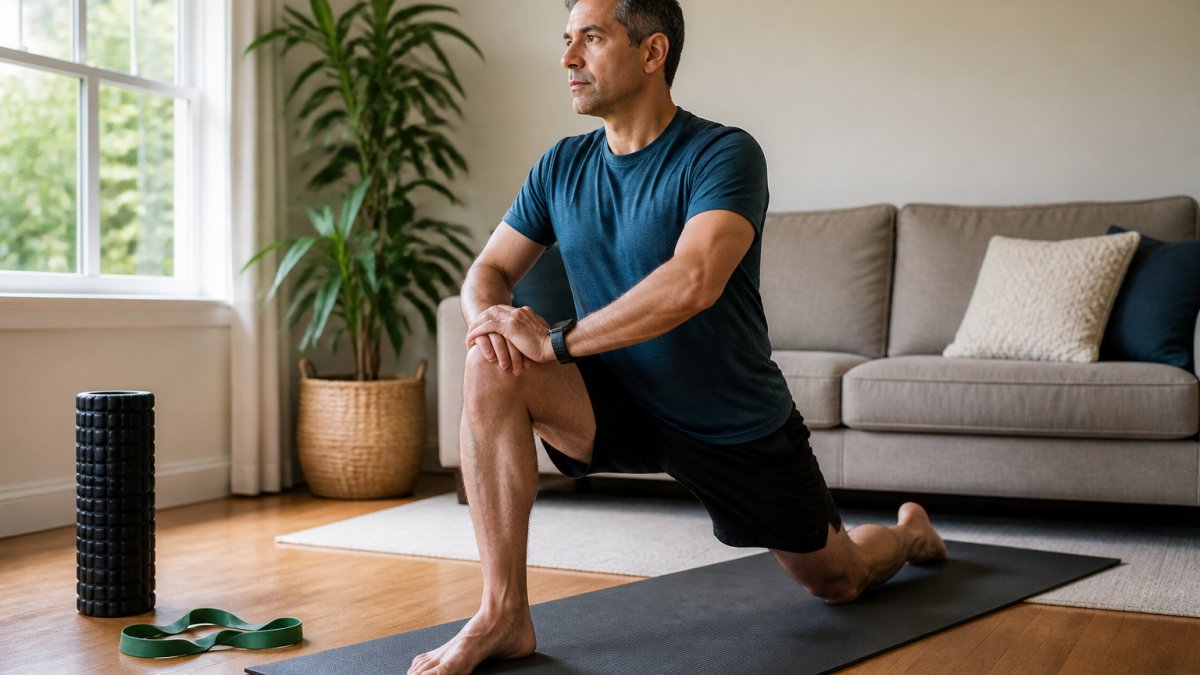
You can make real progress at home, but only with a structured plan. Random stretching won’t cut it. Below is the framework we use with patients who want to regain lost mobility between visits.
Step 1: Assess Your Starting Point and Set a Baseline
Before you change anything, write down where you are today. Test these five movements:
- Touch your toes without bending your knees
- Turn your head side to side
- Raise both arms overhead
Rate each from 1 (easy) to 5 (very hard). That’s your baseline. Without it, you can’t tell if you’re improving.
Go one layer deeper than the rating. For each movement, note three things:
- Where you feel the limit, a joint that feels blocked, a muscle that feels tight, or a vague pull that spreads
- What the limit feels like, a hard stop, a soft stretchy end range, or pain that stops you before the motion does
- When it shows up, only in the morning, only after activity, or all day
Those three notes separate a joint problem from a soft-tissue problem from a pain-sensitivity problem. A hard stop usually points toward a joint that isn’t gliding well; a soft, stretchy limit toward muscle tightness; pain before the motion ends toward an irritated tissue or nerve.
Step 2: Build a Daily Movement Routine That Fits Your Schedule
Consistency beats intensity: ten focused minutes daily outperforms one long weekend session. Aim for:
- 5 minutes of gentle stretching in the morning
- 5 minutes of strengthening in the evening
- A short walk most days
Keep it simple enough that you’ll actually do it. A routine you skip doesn’t help.
Match the routine to what you found in Step 1:
- Hard stop in a joint: prioritize gentle range-of-motion work and joint mobilization before stretching. Stretching a joint that won’t glide can irritate it.
- Soft, stretchy limit in a muscle: prioritize static stretching after activity and dynamic stretching before.
- Pain that arrives early: prioritize isometric holds and low-load strengthening, and keep motion inside the pain-free range.
Step 3: Progress One Variable at a Time
Progress is not “do more.” Progress is changing one thing and watching what happens. Use this order:
- Frequency first, add a day before you add reps.
- Reps or time second, add 2 reps or 10 seconds per set.
- Range third, move slightly deeper only after the first two are easy.
- Load last, add resistance only when the movement is pain-free and controlled.
Hold each change for one to two weeks before making the next. If pain rises above a 4 out of 10 during or after a session, drop back to the last manageable version for a few days.
Step 4: Track Progress and Adjust Every Two Weeks
Every two weeks, retest your five baseline movements. If a number improves, keep going. If it’s stuck or worse, change one thing: add an exercise, reduce intensity, or see a provider.
Track more than the 1-to-5 rating. Write down:
- Range of motion, how far you can reach, turn, or bend, measured against a wall, a line on the floor, or your own hand position
- Walking tolerance, how many minutes you can walk before symptoms start
- Pain during activity, the highest number during the session, not just after
If none of those four measures move after four to six weeks of consistent effort, get a professional assessment rather than push harder.
The biggest mistake is people adding exercises faster than their body can adapt. Change one variable at a time. That way, you know exactly what’s working.
Step 5: Remove the Barriers That Stall Progress
Treatment and exercise are only part of the picture. Four everyday factors quietly limit how fast mobility returns:
- Sleep, most adults need seven to nine hours. Short sleep raises pain sensitivity and slows tissue recovery.
- Work ergonomics, a screen below eye level, a chair that forces a slouch, or hours in one position can undo a morning routine by lunch.
- Daily activity level, long stretches of sitting stiffen joints faster than most people realize. Standing up every 30 to 45 minutes is a low-cost fix.
If progress stalls, check these four before you change the exercises.
Exercises to Improve Mobility Without Aggravating Pain
The right exercises to improve mobility build range of motion without flaring pain. If a movement spikes pain above a 4 out of 10, stop and modify it.
Book your consultation today! →
Match the Exercise to the Cause, Not the Symptom
Exercise is not one thing. Different types work on different problems, and using the wrong type is why some people stretch for months and see nothing change.
- Static stretching lengthens tissue that is genuinely short. It works best after activity, when muscles are warm, and it does little for a joint that is stiff for mechanical reasons.
- Dynamic stretching moves a joint through its range under control. It works best before activity and is a better warm-up than holding a stretch cold.
- Isometric holds contract a muscle without moving the joint. They are often the safest starting point when pain arrives early in a range.
A common pattern is to pair one flexibility exercise with one strengthening exercise for the same area. Range without strength rarely holds.
A Starter Set You Can Do at Home
Try these, and stop any that reproduce sharp or radiating pain:
- Cat-cow: 10 slow reps for spinal mobility
- Hip flexor stretch: 30 seconds per side
- Shoulder circles: 10 each direction
For conditioning, focus on low-impact exercise. Swimming, cycling, and walking build stability without pounding your joints. Yoga combines flexibility and strength in one session, though some poses load the spine and knees in ways that don’t suit every problem, modify rather than push through.
What the Evidence Actually Supports
Know what each approach can and cannot do, so you don’t expect more than it delivers:
- Exercise therapy has the strongest and most consistent support for improving function in common back, hip, and knee complaints. It is not a quick fix; most people see meaningful change over six to twelve weeks of consistent work.
- Manual therapy and soft-tissue work can reduce pain and improve range in the short term. The effect tends to be temporary unless it is paired with exercise and activity change.
- Chiropractic adjustment can improve range and reduce pain for some mechanical spine and joint problems. It works best as part of a plan that includes strengthening and daily movement, not as a stand-alone fix.
None of these approaches reverses arthritis or repairs a torn structure. What they can do is reduce pain enough to move, and movement is what restores function over time.
Pushing through sharp pain is the fastest way to set yourself back. Soreness is fine. Sharp, stabbing, or radiating pain is not. Stop and get it checked.
How to Tell If an Exercise Is Working
Judge an exercise by the 24 hours after, not just during. A good session leaves you moving easier the next day. If you’re stiffer, sorer, or more limited, it was too much, reduce the range, reps, or load and try again.
Physical Therapy for Mobility: What to Expect and When It Helps
Physical therapy for mobility works best when there’s a clear mechanical problem to correct. A therapist assesses your movement patterns, then builds a plan around your specific limits.
A typical session includes:
- Hands-on joint mobilization and soft-tissue treatment
- Guided therapeutic exercise
- Home program updates
It helps most with post-injury rehab, post-surgical recovery, and chronic patterns that haven’t responded to self-care. According to the American Physical Therapy Association, movement is medicine, and tailored exercise is a core part of recovery.
Where it falls short: therapy alone can’t fix every cause. Some cases need regenerative or interventional care first.
When Limited Mobility Needs Medical Evaluation
Some symptoms mean stop and get seen, not stretch harder. See a provider promptly for:
- Numbness, tingling, or weakness in an arm or leg
- Loss of bowel or bladder control
- Unexplained weight loss with back pain
These can point to nerve compression, fracture, or other serious issues. The National Institute of Neurological Disorders and Stroke notes that early evaluation improves outcomes for many spine and nerve conditions.
Don’t wait it out. A quick exam rules out the dangerous stuff and gets you on the right path sooner.
Measuring Progress: How to Know You’re Actually Regaining Mobility
Progress isn’t just “feeling better.” Track hard numbers. Retest your five baseline movements every two weeks. Note how far you can reach, how long you can walk, and how many stairs you can climb without stopping.
Other signs you’re on track:
- Morning stiffness fades faster
- You need less pain medication
- Daily tasks feel easier
If nothing changes after four to six weeks of consistent effort, that’s your signal to get professional help.
Preventing Relapse: How to Keep Mobility Long-Term
Mobility is a habit, not a one-time fix. Once you regain movement, protect it. Keep a short daily routine even when you feel fine. Stay active with walking, swimming, or cycling. Address small aches before they become big ones.
Consistency, not intensity, is what protects your joints for the long haul.
Conclusion: Your Next Step Toward Lasting Mobility
Stretching and self-care can take you far, but some root causes need a trained eye and the right tools. At Advanced Health Center, we’ve helped over 10,000 patients find lasting relief without drugs or surgery. Our non-surgical treatments target the root cause of back, neck, and joint pain, and our team has managed auto injury cases for over 40 years.
Frequently Asked Questions
How long does it take to regain mobility?
Timelines vary based on the cause, your age, and how consistently you follow a plan. Some people notice less morning stiffness within two to three weeks of daily gentle stretching and low-impact activity. Regaining full range of motion after an injury or years of limited movement often takes eight to twelve weeks. Tracking small wins, like bending further or walking without a limp, keeps motivation steady.
Can physical therapy help restore mobility if I’ve already tried it before?
Yes, but the approach matters. Physical therapy for mobility works best when it targets the root cause, not just the sore spot. If a previous round focused only on pain relief, ask for a reassessment that includes movement patterns, joint mobilization, and strengthening. A personalized treatment plan that progresses from controlled exercises to functional movements often produces better long-term results than passive treatments alone.
When should I see a health care professional about reduced mobility?
See a professional if mobility loss comes on suddenly, follows a fall or accident, or comes with numbness, tingling, or weakness in your legs or arms. Also seek evaluation if pain wakes you at night, you can’t bear weight, or home exercises make symptoms worse after two weeks. Chronic pain that limits daily activities like dressing or climbing stairs also warrants a medical assessment to rule out serious joint or nerve issues.
What are the best exercises for improving mobility safely?
Start with dynamic stretching like leg swings and arm circles to warm up, then move into gentle static stretches held for 20 to 30 seconds. Add strengthening moves such as sit-to-stands, wall push-ups, and glute bridges to support joint stability. Low-impact activities like swimming, cycling, and yoga build endurance without jarring your joints. Stop any exercise that causes sharp pain and check with a professional before progressing.