

Table of Contents
- Frozen Shoulder and Treatment: What Actually Happens in the Joint
- Freezing, Frozen, Thawing: The Frozen Shoulder Recovery Timeline
- Adhesive Capsulitis Exercises You Can Start at Home
- Non-Surgical Treatment for Shoulder Pain: What Actually Works
- Frozen Shoulder and Treatment Options When Nothing Else Has Worked
- The Emotional Side of Frozen Shoulder Recovery
- Frequently Asked Questions
Last Updated: September 13, 2026
Frozen Shoulder and Treatment: What Actually Happens in the Joint
Frozen shoulder and treatment decisions start with one fact: adhesive capsulitis happens when the shoulder’s joint capsule thickens and tightens around the glenohumeral joint. At Advanced Health Center, we understand that the capsule loses elasticity, synovial inflammation builds, and shoulder mobility shrinks in every direction.
Adhesive capsulitis is a condition in which the connective tissue surrounding the shoulder joint becomes inflamed and stiff, causing progressive loss of range of motion and pain that can last for years if untreated.
The rotator cuff usually isn’t the problem, which is why so many people get misdiagnosed early. It’s the capsule, not the tendon.
Who Is Most at Risk
Diabetic risk factors top the list: people with diabetes develop adhesive capsulitis far more often than the general population, and their cases run longer (PubMed). Thyroid conditions, recent shoulder immobilization after injury or surgery, and age 40 to 60 also raise risk (orthoinfo.aaos.org). Women are affected more often than men.
A common mistake is waiting months before an orthopedic evaluation. The earlier the diagnosis, the more treatment options stay open.
Freezing, Frozen, Thawing: The Frozen Shoulder Recovery Timeline
The frozen shoulder recovery timeline runs through three phases, and knowing which one you’re in changes how you treat it. Freezing brings escalating pain as the capsule contracts. Frozen trades sharp pain for deep stiffness and functional impairment. Thawing is where range of motion slowly returns.
How Long Each Stage Lasts
| Phase | Typical Duration | Dominant Symptom | Main Goal |
|---|---|---|---|
| Freezing | 2-9 months | Pain with movement | Calm inflammation, protect sleep |
| Frozen | 4-12 months | Stiffness, lost motion | Maintain what’s left, gentle mobility |
| Thawing | 5-24 months | Gradual return of motion | Rebuild strength and function |
Timelines vary widely. Some people move through all three phases in under a year; others take three years or more. The American Academy of Orthopaedic Surgeons overview of frozen shoulder notes that most cases eventually resolve, but “eventually” is doing a lot of work in that sentence.
Adhesive Capsulitis Exercises You Can Start at Home
Adhesive capsulitis exercises work best when they match the phase you’re in, not the phase you wish you were in. During freezing, the goal is gentle motion without provoking pain. During frozen and thawing, you can push further into passive and active range of motion work.
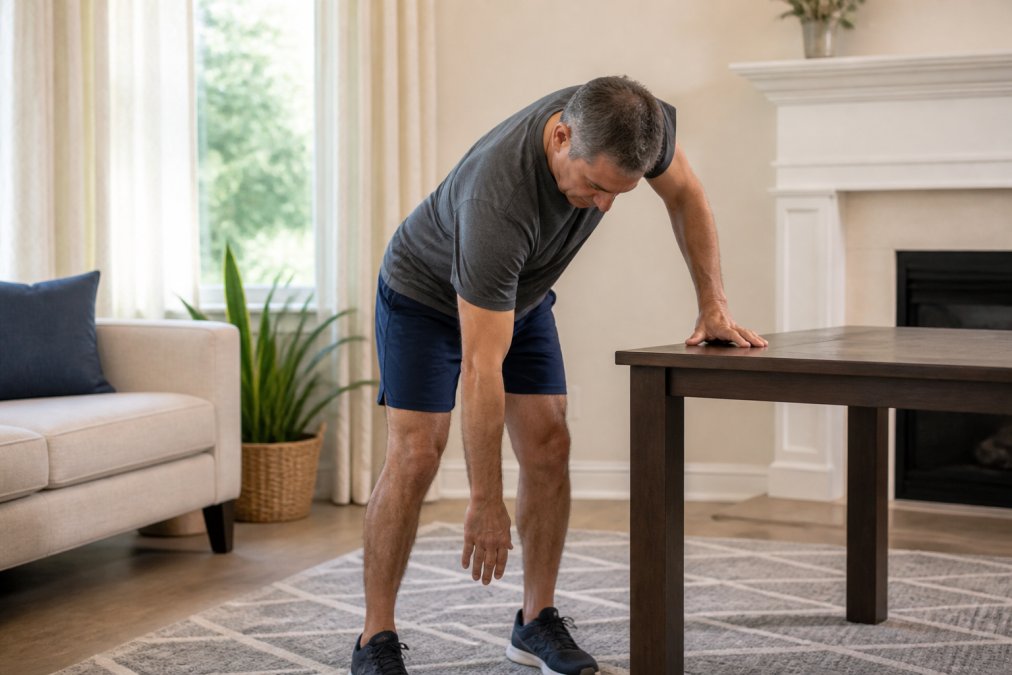
Start with these:
- Pendulum swings – Lean forward, let the arm hang, and make small circles. Two sets of 10 in each direction.
- Table slides – Sit at a table, slide the hand forward on a towel until you feel a stretch, hold 10 seconds.
- Cane-assisted flexion – Lie on your back, hold a cane with both hands, and use the good arm to lift the stiff one overhead.
- Cross-body reach – Gently pull the affected arm across your chest with the other hand.
- Doorway external rotation – Bend the elbow 90 degrees against a doorframe and rotate the forearm outward.
When to Push and When to Back Off
Pain during the exercise is acceptable. Pain that lingers more than 30 minutes afterward, or that wakes you at night, means you pushed too hard. Back off the range, not the frequency.
Stretching aggressively through sharp pain during the freezing phase can prolong inflammation and set your recovery back weeks. If a stretch produces a catching or stabbing sensation, stop and reassess with a clinician.
Non-Surgical Treatment for Shoulder Pain: What Actually Works
Non-surgical treatment for shoulder pain from adhesive capsulitis is a sequence, and the order matters as much as the tools. The standard ladder runs from anti-inflammatory medication and activity modification, to physical therapy, to corticosteroid injection, to hydrodistension, and only then to surgery. Most people never reach the last rung.
Medication Management and What NSAIDs Actually Do
NSAIDs such as ibuprofen, naproxen, and prescription-strength options reduce the synovial inflammation driving freezing-phase pain. They do not restore range of motion or shorten the condition, they make the freezing phase survivable enough to sleep and do therapy. That distinction matters: patients who expect NSAIDs to “fix” the shoulder stop doing the work that actually does.
Acetaminophen is an alternative when NSAIDs are poorly tolerated, though it addresses pain without touching inflammation. Topical NSAIDs suit patients with gastrointestinal or cardiovascular contraindications to oral dosing. Anyone with kidney disease, an ulcer history, or blood thinners should clear NSAID use with a clinician first.
Corticosteroid Injections: What to Expect and When They Help
An intra-articular corticosteroid injection delivers a strong anti-inflammatory agent directly into the glenohumeral joint, suppressing the synovitis that drives capsular contracture. Many patients notice meaningful pain relief within days and improved motion over the next two to six weeks.
Two details separate a good injection from a wasted one. First, ultrasound guidance: blind injections miss the joint capsule more often than most patients realize, and a miss means a needle stick with no benefit. Second, timing: injections work best in the freezing and early frozen phases, when inflammation still dominates. In late frozen or thawing phases, the capsule is already fibrotic and the steroid has less to work on.
Injections are not unlimited. Repeated corticosteroid dosing into the same joint risks temporary blood sugar elevation (a real consideration for diabetic patients), skin and fat atrophy at the injection site, and, with frequent repetition, potential cartilage effects. Most practitioners limit injections to a small number per shoulder per year.
Hydrodistension: Stretching the Capsule From the Inside
Hydrodistension, sometimes called hydrodilatation, injects a larger volume of sterile fluid, often saline with steroid and sometimes local anesthetic, into the joint capsule under imaging guidance. The fluid distends the capsule beyond its contracted state, mechanically stretching tissue while the steroid addresses inflammation.
Patients often report relief within days, and the procedure is typically outpatient without general anesthesia. It works best in the frozen phase, when the capsule is stiff but not yet densely scarred. Response varies: some get months of improved motion from one session, others only partial benefit and may need a repeat.
Physical Therapy: The Variable That Determines Your Outcome
Physical therapy is the only intervention here that changes the final range of motion you end up with. Injections and hydrodistension create a window of reduced pain and increased mobility; therapy is what you do inside it.
Therapy for adhesive capsulitis is staged deliberately. Freezing phase: gentle pendulum work, scapular stabilization, and pain-free range of motion, prevent further loss, don’t force gains. Frozen phase: sustained stretching, joint mobilization, and cane- or pulley-assisted range of motion. Thawing phase: strengthen the rotator cuff and scapular muscles weakened by months of disuse.
Frequency matters: most protocols call for two to three therapist sessions per week plus a daily home program. Patients who do the home work consistently recover faster and further than those relying on clinic visits alone.
Schedule your first physical therapy session within days of a corticosteroid injection, while the joint is still numbed and the capsule is more compliant. That window closes within a couple of weeks, and it’s the single highest-leverage scheduling decision in the whole treatment plan.
What Doesn’t Work
A few interventions are commonly tried and rarely help. Aggressive stretching during the freezing phase prolongs inflammation rather than accelerating recovery. Chiropractic manipulation that doesn’t address the capsule won’t change the contracture. And complete immobilization is counterproductive at every stage, because the capsule tightens further without movement, the one exception is short-term sling use during an acute flare, and only for a few days.
Book your consultation today! →
Frozen Shoulder and Treatment Options When Nothing Else Has Worked
Frozen shoulder and treatment plans that stall usually stall for one reason: the capsule was never fully addressed. When months of therapy, injections, and home exercise produce no measurable gain in passive range of motion, the next tier is procedural. Each option carries trade-offs, and the right choice depends on how long you’ve been stuck, how dense the contracture is, and what imaging shows.
Manipulation Under Anesthesia
Manipulation under anesthesia, or MUA, is exactly what it sounds like: under sedation or general anesthesia, the physician moves the shoulder through its full range of motion, forcibly tearing the contracted capsule and adhesions. Because you’re asleep, the muscles are relaxed and the shoulder can be taken further than while you’re awake and guarding.
MUA is fast, the procedure takes minutes, and many patients wake with substantially more motion. The catch is what happens next: gains are only maintained if aggressive physical therapy begins immediately, often the same day or the next. Patients who skip that step lose much of the improvement as the capsule re-scars.
Risks include humeral fracture, dislocation, rotator cuff tear, and labral injury. Fracture risk is why MUA is used cautiously in patients with osteoporosis or weakened bone, and it works better in earlier-stage disease than in a capsule densely fibrotic for years.
Arthroscopic Capsular Release
Arthroscopic capsular release is the surgical gold standard for adhesive capsulitis that has failed conservative care. Through small portals, the surgeon uses a radiofrequency probe or shaver to cut the contracted capsule, typically the anterior and inferior portions, the most restricted. It’s precise in a way MUA is not: the surgeon sees exactly which tissue is released and can address other intra-articular problems at the same time.
Recovery is faster than most patients expect from shoulder surgery. Range of motion often improves immediately, and many begin gentle motion exercises within 24 hours. A sling is used only briefly, if at all, because early movement is the point. Full recovery still takes months of therapy, but the trajectory is usually steeper than an untreated frozen shoulder’s natural history.
Risks include infection, rare nerve injury, stiffness recurring if therapy isn’t maintained, and the standard risks of anesthesia and arthroscopy. Capsular release is generally reserved for patients who have failed several months of conservative treatment and whose function is significantly impaired.
Hydrodistension Under Imaging as a Bridge
Before committing to surgery, some patients benefit from a repeat hydrodistension under fluoroscopy or ultrasound with a larger volume or different fluid composition than the first attempt. It’s less invasive than either surgical option and can sometimes break a plateau. Response is unpredictable and it’s no substitute for capsular release in a densely contracted shoulder, but it’s reasonable for patients who want to exhaust non-surgical options first.
How to Decide
The decision comes down to three questions: How long have you been stuck? How much passive range of motion have you lost? And how much has it cost you functionally, sleep, work, dressing, driving? Patients frozen more than six months with severe functional loss tend to do better with capsular release than continued conservative care. Those earlier in the course, or with milder restriction, usually gain more from another round of injection plus therapy.
A second opinion is worth getting before any surgical decision, not because the first surgeon is wrong, but because the threshold for operating varies meaningfully between practices, and the condition does eventually resolve on its own in most people. The question is whether you’re willing to wait out the timeline.
If you’ve done six months of therapy with no measurable gain in passive range of motion, it’s time for a new evaluation, not more of the same exercises. Ask specifically about imaging, candidacy for capsular release, and what the post-procedure therapy schedule would look like.
The Emotional Side of Frozen Shoulder Recovery
The psychological impact of chronic pain is the part clinical guides skip, and it’s the part patients talk about most. Losing the ability to dress yourself, sleep on your side, or reach a seatbelt wears people down. Sleep deprivation compounds it. Anxiety about whether the shoulder will ever work again is normal, not a sign you’re handling it poorly.
Two things help. Patient-reported outcome measures give you an objective record of progress when it feels like none is happening. And home ergonomic tweaks reduce daily strain: move the coffee mug to a reachable counter, sleep with a pillow supporting the affected arm, and switch to a backpack instead of a shoulder bag.
Dietary and lifestyle support matters too. Sleep, blood sugar control, and less processed food won’t cure adhesive capsulitis, but they lower the inflammatory load your body is fighting.
Frozen shoulder recovery tests patience more than it tests strength, and the people who do best are the ones who get an accurate diagnosis early and treat each phase on its own terms. If you’re in the San Jose area and conventional care hasn’t restored your shoulder mobility, Advanced Health Center offers non-surgical, drug-free treatment focused on the root cause of the problem. Our team brings over 40 years of experience with complex cases and a natural, multi-faceted approach to restoring function. Book your consultation today and find out what’s actually driving your shoulder pain.
Frequently Asked Questions
What’s the fastest way to heal a frozen shoulder?
There is no overnight fix, but the fastest path combines consistent physical therapy with pain management. Non-steroidal anti-inflammatory drugs and corticosteroid injections can reduce synovial inflammation during the freezing phase, making exercise tolerable. A 2026 review of rehabilitation protocols found that patients who started guided stretching within six weeks of symptom onset regained range of motion roughly 30% faster than those who waited. Work with a clinician to match treatment intensity to your stage.
What should you not do with a frozen shoulder?
Avoid forcing your arm through painful ranges, especially during the freezing phase. Aggressive stretching can worsen capsular contracture and trigger more inflammation. Skip heavy overhead lifting, contact sports, and any movement that causes sharp pain. Also avoid relying on rest alone; complete immobilization accelerates stiffness. If a movement hurts beyond a mild stretch sensation, stop and modify the exercise rather than pushing through.
What is the most effective treatment for frozen shoulder?
For most people, a combination works best: physical therapy to restore shoulder mobility, corticosteroid injections for pain relief, and a home exercise routine. When conservative care stalls, hydrodistension or manipulation under anesthesia can break up adhesions. Arthroscopic capsular release is reserved for severe, persistent cases. A clinical diagnosis from an orthopedic evaluation ensures the treatment matches your stage and underlying risk factors, including diabetic risk factors.
Does a frozen shoulder ever go back to normal?
Yes, the vast majority of people regain functional range of motion, though full recovery can take 12 to 18 months without treatment. With a structured rehabilitation protocol, many patients see meaningful improvement in 6 to 9 months. Some residual stiffness may remain, particularly in external rotation. Early intervention and consistent adhesive capsulitis exercises significantly improve outcomes and reduce long-term functional impairment.
How long does the freezing stage of frozen shoulder last?
The freezing phase typically lasts 6 weeks to 9 months. Pain increases gradually while range of motion declines. This is when synovial inflammation is most active, so treatment focuses on pain management rather than aggressive stretching. Recognizing this stage helps you avoid exercises that aggravate the joint capsule. If pain persists beyond nine months without improvement, seek an orthopedic evaluation to rule out other causes.
Can I keep working at a desk job during frozen shoulder treatment?
Yes, most people continue working. Adjust your workstation to reduce strain: keep your keyboard at elbow height, use a headset instead of cradling a phone, and avoid reaching behind you for items. A physical therapist can suggest ergonomic modifications and simple desk stretches. If your job requires overhead work or heavy lifting, you may need temporary restrictions during the freezing phase.
Are there non-surgical treatment for shoulder pain options beyond physical therapy?
Yes. Ultrasound-guided injection delivers medication precisely to the inflamed capsule. Hydrodistension uses fluid pressure to expand the joint. Oral non-steroidal anti-inflammatory drugs manage pain. Some patients benefit from acupuncture or dry needling for pain relief. A 2026 clinical review found that combining two or more non-surgical approaches improved shoulder function scores more than any single method alone.