

Table of Contents
- What Is Prolotherapy for Joint Pain?
- Conditions Treated with Prolotherapy
- How the Procedure Works: Step-by-Step
- Prolotherapy vs Cortisone Injections
- Prolotherapy Recovery Time and Aftercare
- How Many Prolotherapy Sessions Are Needed?
- Regenerative Medicine for Knee Rejuvenation
- Is Prolotherapy Right for You?
- Frequently Asked Questions
Last Updated: September 24, 2026
What Is Prolotherapy for Joint Pain?
Prolotherapy for joint pain is a regenerative injection treatment that uses a mild irritant solution, most often dextrose, to trigger the body’s own healing response in injured ligaments, tendons, and joints. At Advanced Health Center, we help patients understand this option before they commit to it.
The Science Behind Regenerative Injection Therapy
Regenerative injection therapy works by creating a deliberate, controlled injury at the tendon-bone junction or within a lax ligament. The irritant solution damages cells just enough to start a healing cascade without causing lasting harm.
NIH overview of regenerative injection therapies
Conditions Treated with Prolotherapy
Prolotherapy is used for musculoskeletal pain driven by unstable or poorly healed connective tissue. It is not a treatment for every kind of pain, and matching the condition to the treatment matters more than the injection technique itself.
Chronic Joint Pain and Osteoarthritis
Chronic joint pain from mild to moderate osteoarthritis often involves lax supporting ligaments, not just cartilage wear. When those ligaments can’t hold the joint properly, joint stability drops and pain increases with activity.
Ligament Laxity and Tendinopathy
Ligament laxity after an injury, or tendinopathy that hasn’t resolved with rest, are two of the strongest indications. In both cases, the tissue has healed incompletely: it’s structurally present but mechanically weak.
How the Procedure Works: Step-by-Step
A prolotherapy session is short, but the preparation and technique matter as much as the injection itself. Most visits run 20 to 40 minutes, depending on how many sites are treated and whether imaging guidance is used.
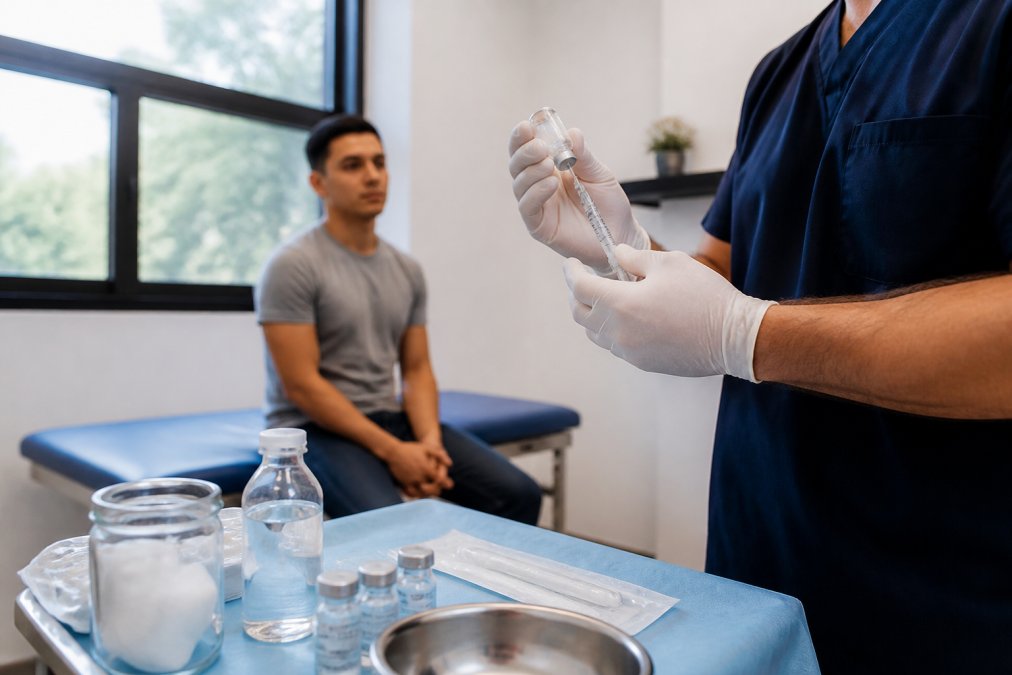
Before the Procedure
Preparation starts days before the appointment, not in the exam room.
- Medication review. Tell your provider about every medication and supplement you take. Nonsteroidal anti-inflammatory drugs (NSAIDs) such as ibuprofen, naproxen, and aspirin, plus corticosteroids, can blunt the inflammatory response prolotherapy depends on. Many practitioners ask patients to pause NSAIDs for roughly 3 to 7 days before and after a session. Never stop a prescription blood thinner or anticoagulant on your own, that decision belongs to the prescriber.
- Hydration and meals. Eat a normal meal and drink water beforehand. Some patients feel lightheaded after multiple injections, and low blood sugar makes that worse.
- Clothing. Wear loose clothing that exposes the treatment area. A knee or shoulder is easy to access; a hip or low back may require a gown.
- Transportation. Most patients drive themselves home. If several joints are treated or you are anxious about needles, arrange a ride.
During the Procedure
- Assessment and mapping. The provider palpates the joint, tests for laxity, and identifies tender or unstable attachment points. Ultrasound is often used to confirm targets and avoid injecting the wrong structure.
- Skin preparation. The site is cleaned with an antiseptic such as chlorhexidine or iodine and allowed to dry.
- Local anesthetic. A small amount of lidocaine or a similar agent numbs the skin and immediate tissue. Some clinicians mix the anesthetic with the proliferant; others use it only for the skin.
- Injection. The proliferant solution, most often dextrose at concentrations ranging from about 12.5% to 25%, is placed at each damaged attachment point. A single session may involve anywhere from a few injections to more than a dozen, depending on the joint and the number of structures involved.
- Brief observation. You rest for 10 to 15 minutes so the provider can confirm there is no immediate reaction.
- Discharge instructions. You receive written aftercare guidance, a medication plan, and a follow-up timeline.
What You Feel
Expect a burning or pressure sensation as the solution goes in. The anesthetic takes the edge off, but prolotherapy is not painless, the deliberate irritation is the point. Soreness typically builds over the first 24 to 48 hours and then gradually subsides.
Ask your provider to mark injection sites on a diagram before starting. It helps you track which areas respond and which need adjustment at the next session.
Imaging Guidance: When It Matters
Not every prolotherapy injection requires ultrasound, but for deeper structures, the sacroiliac ligaments, the hip capsule, the rotator cuff attachments, image guidance improves accuracy and reduces the chance of injecting the wrong tissue. Ask whether your provider uses ultrasound, and if not, why.
American Academy of Orthopaedic Surgeons on injection therapies
Prolotherapy vs Cortisone Injections
The two treatments do opposite things. Cortisone suppresses inflammation and relieves pain quickly, but it can weaken tissue with repeated use. Prolotherapy deliberately creates inflammation to rebuild tissue, so relief builds slowly.
| Factor | Prolotherapy | Cortisone Injection |
|---|---|---|
| Mechanism | Provokes healing response | Suppresses inflammation |
| Onset of relief | Weeks | Hours to days |
| Duration per session | Months, cumulative | Weeks to months |
| Repeat use | Encouraged | Limited |
| Effect on tissue | Strengthens | Can weaken with overuse |
American Academy of Orthopaedic Surgeons on injection therapies
Prolotherapy Recovery Time and Aftercare
Prolotherapy recovery time is short on paper and longer in practice. Most patients return to desk work the same day or next. Strenuous activity needs 1 to 2 weeks off.
Aftercare essentials:
- Avoid anti-inflammatory medications for the first week; they blunt the response you paid for
- Ice only if swelling is significant, and briefly
- Move gently, but don’t immobilize the joint
- Begin post-injection physical therapy once soreness fades, usually within 7 to 14 days
Taking ibuprofen or naproxen in the first week after injection can suppress the inflammatory response prolotherapy depends on. Ask your provider before reaching for any anti-inflammatory.
How Many Prolotherapy Sessions Are Needed?
How many prolotherapy sessions are needed varies by condition, but most patients need 3 to 6 sessions spaced 3 to 6 weeks apart. Chronic or multi-joint cases sometimes need more.
Book your consultation today! →
Signs you’re ready for the next session:
- Soreness from the last injection has fully resolved
- Function has improved but plateaued
- The provider finds residual laxity on exam
Regenerative Medicine for Knee Rejuvenation
Regenerative medicine for knee rejuvenation applies the same prolotherapy principles to the knee’s supporting structures: the collateral ligaments, the patellar tendon, and the joint capsule. Knee osteoarthritis with ligament laxity is one of the most common reasons patients seek this out.
MedlinePlus on joint injection procedures
Is Prolotherapy Right for You?
Prolotherapy is a reasonable option if you have chronic joint pain, ligament laxity, or tendinopathy that has not responded to rest, physical therapy, or short-term injections, and you want a non-surgical treatment without long-term medication. It is a poor fit for some patients, and knowing which group you fall into saves time and money.
Who Tends to Do Well
- Adults with mild to moderate osteoarthritis and ligament laxity around the joint
- Athletes or active adults with tendinopathy that has plateaued after conservative care
- Patients who want to delay or avoid surgery and are willing to commit to a multi-session plan plus rehab
- People who can tolerate a few days of post-injection soreness and will follow aftercare instructions
Who Should Avoid It
This is the part most clinic websites bury. Prolotherapy is generally not appropriate if you have:
- An active infection at or near the injection site, or a systemic infection
- A bleeding disorder or are taking anticoagulants without clearance from the prescriber
- An autoimmune condition that affects connective tissue, such as lupus or rheumatoid arthritis, where the healing response may be unpredictable
- An allergy to the proliferant, the anesthetic, or the preservatives used in the solution
- Pregnancy, unless specifically cleared by your obstetric provider
- Active cancer or immunosuppression, which can alter how the body responds to a provoked injury
Cost and Coverage: What to Expect
Most insurance plans treat prolotherapy as investigational or experimental for joint pain, which means you will likely pay out of pocket. Cash-pay pricing varies widely by region, provider, and joint treated, so there is no single national number to quote. What you can control is how you verify the cost before you commit.
A practical checklist:
- Call your insurer first. Ask specifically whether prolotherapy (CPT codes vary; ask the billing office which codes they use) is covered, and whether a prior authorization is required.
- Request a written treatment plan. It should list the number of sessions, the per-session cost, what imaging or follow-up visits are included, and what happens if you do not respond.
- Ask about package pricing versus per-session pricing. Some clinics discount a series; others charge per visit. Know which model you are agreeing to.
- Check your HSA or FSA. Prolotherapy may qualify as a reimbursable medical expense even when insurance does not cover it. Keep receipts and a letter of medical necessity from your provider.
- Confirm the refund or adjustment policy. If three sessions produce no change, what does the clinic do?
How to Judge Whether It Is Working
Patient-reported outcome measures, or PROMs, are how you should track progress, not just how you feel on a given day. Before your first session, write down:
- Your pain score on a 0 to 10 scale at rest and with activity
- How far you can walk or how long you can stand before pain limits you
- Which daily activities (stairs, driving, sleeping through the night) are affected
Prolotherapy rewards patients who prepare, verify costs up front, and track objective progress. If a clinic cannot give you a written plan with session count, cost, and outcome measures, that is a signal to keep looking.
MedlinePlus on joint injection procedures
Frequently Asked Questions
What are the potential downsides of prolotherapy?
Prolotherapy can cause temporary soreness, stiffness, or swelling at the injection site for a few days. Serious complications are rare but may include infection or allergic reaction to the solution. Because it triggers inflammation to stimulate healing, some people experience a brief increase in pain before improvement. It is not effective for everyone, and results vary based on the condition and overall health.
What is the average cost of prolotherapy?
Costs vary widely depending on the provider, location, and number of sessions required. Prolotherapy is not typically covered by insurance, so patients often pay out of pocket. At Advanced Health Center, pricing depends on your specific treatment plan. We recommend contacting our clinic directly for a personalized quote and to discuss payment options.
Is prolotherapy better than cortisone?
Cortisone injections reduce inflammation quickly but may weaken tendons and cartilage over time with repeated use. Prolotherapy aims to stimulate tissue repair and improve joint stability, potentially addressing the root cause. The better choice depends on your condition, goals, and how your body responds. Some patients use cortisone for short-term relief while pursuing prolotherapy for longer-term healing.
How long does it take for a joint to heal after prolotherapy?
Most patients notice improvement within 2 to 6 weeks after a session, but full healing can take several months. The inflammatory response and tissue remodeling occur gradually. Recovery time varies based on the joint treated, the extent of injury, and adherence to aftercare instructions. Multiple sessions are often needed to achieve lasting results.
What substances are used in prolotherapy injections?
Common solutions include dextrose (a sugar solution), saline, and sometimes a local anesthetic like lidocaine. These irritants trigger a mild inflammatory response that promotes collagen production and tissue repair. The exact formula depends on the provider and the condition being treated. At Advanced Health Center, we tailor the solution to each patient’s needs.
Does insurance typically cover prolotherapy for joint pain?
Most insurance plans do not cover prolotherapy because it is considered alternative or experimental. Some plans may cover it if deemed medically necessary, but coverage is not guaranteed. Patients usually pay out of pocket. We recommend checking with your insurer and discussing costs with our clinic before starting treatment.
How many prolotherapy sessions are needed for chronic joint pain?
The number of sessions varies based on the severity and duration of your condition. Many patients need 3 to 6 sessions spaced 2 to 6 weeks apart. Chronic issues may require more. Your provider will assess your progress and adjust the plan. Consistency and post-injection physical therapy can improve outcomes.
Can prolotherapy help with knee osteoarthritis?
Prolotherapy is often used for knee osteoarthritis to reduce pain and improve function by strengthening ligaments. Regenerative medicine for knee rejuvenation often includes prolotherapy as a key component.