

Table of Contents
- Why Your Desk Job Hurts: The Real Causes of Chronic Pain
- The Ergonomic Desk Setup for Back Pain That Actually Works
- Stretches for Desk Workers: A 5-Minute Routine to Undo Sitting
- The Benefits of Regenerative Medicine for Chronic Pain
- Natural Pain Management for Desk Workers: Everyday Habits That Add Up
- Hybrid and Remote Work: Ergonomics for Desk Workers Who Move Between Spaces
- When Natural Pain Management for Desk Workers Is Not Enough
- Frequently Asked Questions
Last Updated: September 11, 2026
Why Your Desk Job Hurts: The Real Causes of Chronic Pain
Natural pain management for desk workers starts with understanding why sitting still for eight hours creates so much damage. The human body wasn’t designed to hold one position for that long, and the consequences show up in predictable ways.
Postural imbalances develop when you spend hours hunched over a keyboard. Your chest muscles tighten, your upper back weakens, and your cervical spine gradually loses its natural curve. This isn’t a minor inconvenience. It’s a structural problem that compounds daily.
The Occupational Safety and Health Administration’s ergonomics guidance notes that musculoskeletal disorders remain among the most common workplace injuries, particularly for employees in sedentary roles.
What most guides miss is that the pain isn’t just physical. Chronic desk pain can feed into anxiety, poor sleep, and reduced quality of life. The sedentary lifestyle creates a cycle: pain makes you move less, and moving less makes the pain worse.
Repetitive strain in the wrists, muscle fatigue in the lower back, and joint stiffness in the hips are all predictable outcomes of prolonged sitting. The good news? Most of this is reversible with the right approach.
The Ergonomic Desk Setup for Back Pain That Actually Works
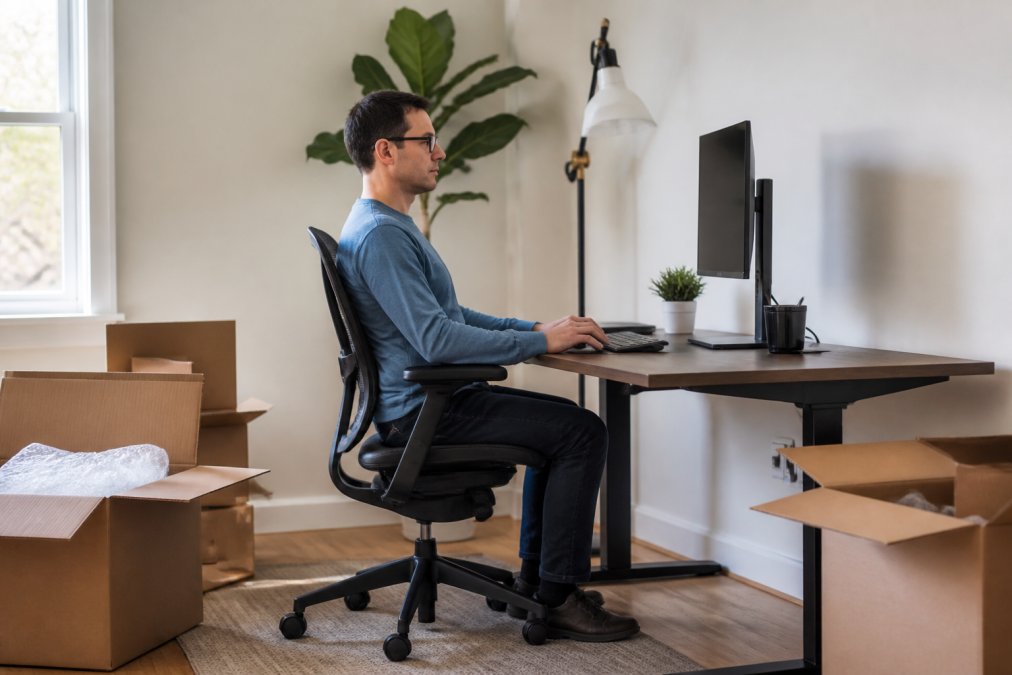
An ergonomic desk setup for back pain doesn’t require expensive equipment. It requires understanding which adjustments matter most and applying them consistently.
What to Fix First: Chair, Monitor, and Keyboard
Start with your chair. The seat height should allow your feet to rest flat on the floor with your knees at roughly 90 degrees. Your lumbar support should maintain the natural inward curve of your lower spine.
Monitor height matters more than most people realize. The top of your screen should be at or slightly below eye level. This keeps your cervical spine in neutral spine alignment instead of craning forward.
For your keyboard, your elbows should rest at about 90 degrees with your wrists straight. If you’re reaching or angling your wrists upward, you’re setting yourself up for repetitive strain.
DIY Ergonomic Hacks With Household Items
You don’t need to spend hundreds on ergonomic equipment. Try these:
- Stack books under your monitor to raise it to eye level
- Roll a towel behind your lower back for makeshift lumbar support
- Use a footstool (or a box) to keep feet supported if your chair is too high
- Place your keyboard on a pillow to angle it slightly downward
These workstation optimization tricks won’t win design awards, but they work.
Set a timer to stand up every 30 minutes. Even 60 seconds of movement resets your postural imbalances and restores circulation to compressed tissues.
Stretches for Desk Workers: A 5-Minute Routine to Undo Sitting
Stretches for desk workers work best when done frequently, not intensely. Five minutes every few hours beats a 30-minute session once a week.
Here’s a routine you can do without leaving your desk:
- Neck rolls: Slowly roll your head in a circle, 5 times each direction
- Shoulder shrugs: Lift shoulders to ears, hold 3 seconds, release. Repeat 10 times
- Seated spinal twist: Turn your torso to the right, hold 15 seconds, switch sides
- Wrist flexor stretch: Extend arm, gently pull fingers back, hold 15 seconds each hand
- Hip flexor stretch: Stand, step one foot forward, lunge gently until you feel the front hip stretch
For thoracic mobility, add a simple cat-cow movement: arch your back, then round it, 10 repetitions.
How to Make a Desk Job Less Sedentary
Microbreaks are the antidote to sedentary lifestyle damage. The goal isn’t exercise. It’s interruption.
Stand during phone calls. Walk to get water instead of keeping a bottle at your desk. Take the stairs when possible. These small changes add up to hundreds of extra movements per day.
Sitting for more than 90 minutes without standing causes your hip flexors to shorten and your glutes to weaken. This creates a postural imbalance that no amount of weekend exercise can fully correct.
The Benefits of Regenerative Medicine for Chronic Pain
Most desk-pain content stops at stretching and posture. It rarely explains what to do when the tissue itself has degraded, when a disc, tendon, or joint has moved past the point where ergonomics alone can reverse the damage. That is the gap this section fills.
Regenerative medicine for chronic pain refers to non-surgical treatments that aim to stimulate the body’s own repair response in injured connective tissue. For desk workers, the relevant targets are narrow and predictable:
- Cervical disc and facet irritation from years of forward head posture
- Lumbar disc strain from prolonged flexed sitting
- Rotator cuff and shoulder impingement from rounded-shoulder positioning
- Wrist and forearm tendon overload from repetitive keyboard and mouse use
How the Mechanisms Differ From Symptom Masking
Over-the-counter pain relievers and muscle relaxants interrupt pain signaling. They do not change the state of the tissue generating the signal. Regenerative approaches work on a different premise: introduce a stimulus, typically a concentrated preparation of the patient’s own blood components or a similar biologic agent, into the damaged area, and let the local inflammatory cascade do repair work rather than simply suppressing it.
Regenerative approaches aim to stimulate the body’s natural repair processes. Patients are often told to expect gradual improvement over several weeks rather than immediate relief.
What This Means Specifically for Desk Workers
Desk-related damage is usually chronic and low-grade rather than acute and traumatic. That profile matters, because it changes which cases are reasonable candidates:
- Tech neck with early disc changes, often a better fit than advanced degeneration with nerve compression
- Chronic lumbar strain without radiculopathy, candidates are typically those whose MRI shows disc or ligament injury but whose symptoms are mechanical, not neurological
- Tendinopathy of the wrist or elbow, a frequent desk-worker complaint that responds poorly to rest alone and is often addressed with regenerative protocols
Where Regenerative Care Fits in a Natural Plan
Regenerative treatment is not a replacement for the daily habits in the rest of this article. It is what you consider when those habits have been applied consistently and the pain still limits work or sleep. Effective approaches often combine three layers:
- Load management, the ergonomic and microbreak changes that stop re-injury
- Progressive strengthening, the core, scapular, and hip work that restores support
- Tissue-directed intervention, the regenerative step that addresses structural damage the first two cannot reach
Regenerative injections are not appropriate for every case. Active infection, certain bleeding disorders, and some immunosuppressive conditions are common contraindications. A proper evaluation, including imaging where indicated, should come before any treatment decision.
::: multidisciplinary pain clinics.
If you have already tried physical therapy, medication, and consistent self-care without lasting relief, the question is no longer whether to stretch more. It is whether the tissue itself needs a different kind of intervention.
Natural Pain Management for Desk Workers: Everyday Habits That Add Up
Natural pain management for desk workers works best as a daily practice, not an emergency response. The habits you build today determine whether you’re in pain next year.
Mindfulness meditation and deep breathing exercises reduce the stress component of chronic pain. Try pursed lip breathing: inhale through your nose for 4 counts, exhale through pursed lips for 6 counts. This activates your parasympathetic nervous system and reduces tension relief.
Thermal therapy helps with flare-ups. Ice packs reduce acute inflammation after a long day of sitting. Heating pads relax tight muscles and improve circulation. Use ice for the first 48 hours after an injury, heat for chronic tightness.
Core stability exercises protect your lower back. Planks, bird dogs, and dead bugs strengthen the muscles that support your spine without straining it.
The most effective natural pain management for desk workers combines movement breaks, targeted stretching, and stress reduction. No single intervention works alone.
Hybrid and Remote Work: Ergonomics for Desk Workers Who Move Between Spaces
The hybrid worker has a problem no single-workstation guide solves: the body adapts to the position it repeats most, and hybrid schedules repeat several positions. Two days properly aligned at an office desk and three days hunched over a laptop on a couch still produce the same postural drift as five bad days. Consistency of alignment matters more than quality of any one setup.
The Three Hybrid Failure Points
Laptop-only work. A laptop forces a trade-off no adjustment can fix: the screen and keyboard are attached, so you either crane your neck down to see the screen or reach up to type. The fix is separation, a stand or stack of books to raise the screen to eye level, plus an external keyboard and mouse at elbow height. This single change eliminates the worst cervical load in remote work.
Couch and bed work. Soft surfaces let the pelvis sink and the lumbar curve collapse. If you must work from a couch, sit at the edge with feet flat, place a firm cushion or folded blanket behind the lower back, and put the laptop on a coffee table or lap desk rather than your thighs. The goal is a hip angle near 90 degrees and a supported lumbar curve, not comfort.
Kitchen-table work. Tables are usually too high relative to a standard chair, which pushes the shoulders up and the wrists into extension. A footstool or box under the feet raises the effective seat height and brings the elbows back to 90 degrees. A rolled towel behind the lumbar spine substitutes for a chair’s missing support.
A Portable Setup That Actually Travels
The kit that solves most hybrid problems fits in a laptop bag:
- A folding laptop stand or a lightweight riser
- A compact external keyboard and mouse
- A rolled lumbar support or an inflatable version
- A small footrest or a folded towel for chair-height mismatches
This is not about buying equipment. It is about ensuring that whatever surface you land on, you can reproduce the same three alignments: screen at eye level, elbows at 90 degrees, feet supported.
The Consistency Rule
For remote vs. office hybrid ergonomics, the operative principle is that your body does not average your positions, it adapts to the one you hold longest. If your home setup is worse than your office setup, the home hours dominate the outcome. The practical implication is to fix the worst environment first, not the best one.
A useful audit: for one week, note which chair, surface, and screen height you use for each work block. The position you log most often is the one to correct first, even if it is not the one that feels worst in the moment.
Keep a duplicate of your essential kit at each regular location if you can. The friction of packing and unpacking is what causes people to skip the setup on tired days, and tired days are when posture degrades most.
The Centers for Disease Control and Prevention’s workplace health resources emphasize that ergonomic adjustments should be applied consistently across all work environments, which is exactly the point hybrid schedules make hardest to follow.
When Natural Pain Management for Desk Workers Is Not Enough
Sometimes self-care isn’t sufficient. Chronic pain management requires professional intervention when pain persists despite your best efforts.
Signs it’s time to seek help:
- Pain that wakes you at night
- Numbness or tingling in your arms or legs
- Pain that limits your ability to work or enjoy hobbies
- Symptoms that haven’t improved after several weeks of consistent self-care
At Advanced Health Center, we offer drug-free pain relief solutions designed to address conditions like low back pain, shoulder injuries, and neuropathy. Our multi-faceted, natural approach has helped patients avoid surgical complications and regain mobility they thought was lost.
The National Institutes of Health’s information on complementary health approaches notes that integrative treatments can be effective for chronic pain when applied appropriately.
If you’ve tried physical therapy, medications, or other interventions without lasting relief, a different approach may help. Our team specializes in cases where conventional treatments have fallen short.
Frequently Asked Questions
What are the most effective natural pain management techniques for office workers?
Start with the basics: fix your ergonomic setup so your monitor sits at eye level and your lower back has support, then take a short movement break every 30 to 45 minutes. Add a five-minute stretching routine for your neck, hips, and upper back. Heat or ice can calm flare-ups, and pursed lip breathing helps release tension. If pain has lasted more than a few weeks, a regenerative medicine evaluation can address the root cause instead of just the symptoms.
How can ergonomic adjustments reduce chronic pain at work?
Ergonomic adjustments reduce repetitive strain by keeping your spine in a neutral position and your joints supported through the workday. Raising your monitor to eye level stops the forward head posture that strains the cervical spine, and a lumbar support keeps the natural curve of your lower back intact. Even small changes, like moving your keyboard closer or adding a footrest, lower muscle fatigue and improve circulation, which cuts down on the daily buildup of tension.
How does a sedentary lifestyle contribute to chronic pain?
Sitting for hours slows circulation, stiffens joints, and weakens the core muscles that support your spine. Over time, those postural imbalances turn into chronic pain in the lower back, neck, and shoulders. The fix is not one long workout at the end of the day but frequent microbreaks, standing every half hour, and short stretches that keep your musculoskeletal health from deteriorating. Small, consistent movement beats occasional intense exercise.
What role does regenerative medicine play in treating desk-related injuries?
Regenerative medicine targets the damaged tissue itself, such as strained ligaments, worn joint cartilage, or irritated tendons, rather than only masking the pain. For desk workers with chronic back or neck pain that has not responded to ergonomic changes and stretching, it offers a drug-free, non-surgical option. A consultation can confirm whether your specific condition qualifies, and treatment plans are tailored to your injury and schedule. Book a consultation to find out if it is right for you.
Chronic desk pain doesn’t have to be your permanent reality. Advanced Health Center offers non-surgical treatments designed to address the root cause of your pain, not just the symptoms. With over 40 years of experience and a focus on natural, drug-free solutions, we’ve helped thousands of patients regain mobility and improve their quality of life. Book your consultation today and discover how our personalized approach can help you live more actively and with less pain.