

Last Updated: October 24, 2026
Quick Summary
Long-term success rates for shoulder stem cell treatments are not well established, because very few shoulder-specific studies report outcomes at five years or more, and those that do are small case series rather than controlled trials. Short- and medium-term improvements are better documented, especially for tendinopathy and partial-thickness tears, so treat any long-term success rate as provisional until it is tied to a defined follow-up period and study design.
- We define success across three dimensions: pain reduction, restored shoulder function, and durability over defined follow-up periods.
- Most published shoulder studies report their earliest meaningful improvements between three and six months.
- Studies of bone marrow aspirate concentrate for rotator cuff tendinopathy generally report sustained improvement at 12 to 24 months.
- Any clinic quoting a precise long-term percentage is almost certainly extrapolating from short-term data or other joints.
- Ask which diagnoses and severities are included before trusting any clinic’s reported success rate.
Table of Contents
- What Long-Term Success Actually Means in Shoulder Stem Cell Therapy
- How Long Do Stem Cell Injections Last in the Shoulder?
- What the Clinical Evidence Says About Long-Term Outcomes
- Stem Cell Injections for Shoulder Arthritis: Results by Diagnosis
- Shoulder Stem Cell Therapy vs Surgery: Comparing Durability
- Shoulder Stem Cell Therapy Risks and Limitations
- Book a Consultation to See If Shoulder Stem Cell Therapy Fits Your Case
- Frequently Asked Questions
What Long-Term Success Actually Means in Shoulder Stem Cell Therapy
Long-term success in shoulder stem cell therapy means sustained pain relief and functional improvement that holds for years, not months. At Advanced Health Center, we define success across three dimensions: pain reduction, restored shoulder function, and durability over defined follow-up periods.
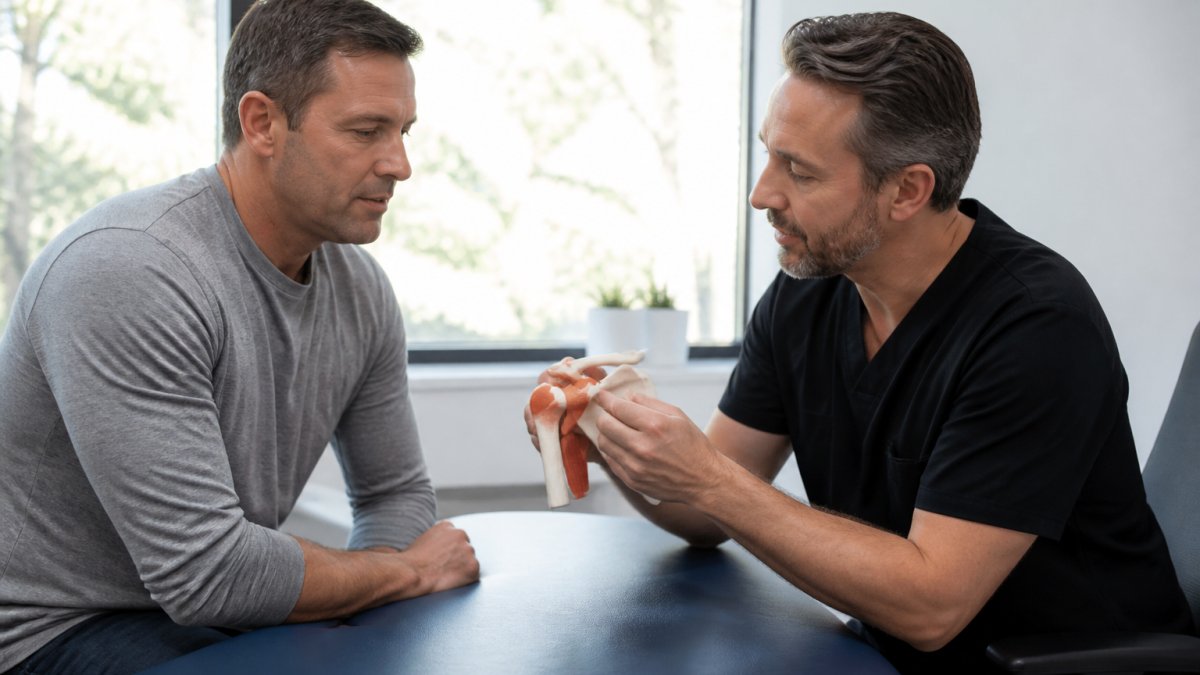
Defining Success: Pain, Function, and Durability
A precise definition matters because “success rate” gets thrown around loosely. A treatment that drops pain scores but leaves you unable to reach overhead is not a success, nor is a shoulder that feels fine at month four and regresses by month eighteen.
We measure success on three tracks:
- Pain: a meaningful, sustained reduction on a validated scale, not a temporary dip
- Function: measurable gains in range of motion and daily activities, from dressing to driving to golf
- Durability: whether those gains hold at two, three, and five years
The third track is where the evidence gets thin. For broader context on what regenerative outcomes look like across conditions, see our guide to regenerative medicine for shoulder injuries.
How Long Do Stem Cell Injections Last in the Shoulder?
Stem cell injections in the shoulder typically produce improvements over weeks to months, with durability varying widely by diagnosis, cell source, and patient characteristics.
What most guides miss is that “how long do stem cell injections last in the shoulder” depends heavily on what is being treated.
A common mistake is treating a single injection as a permanent fix. In practice, durability depends on the tissue’s ability to heal and the mechanical load you place on it afterward.
What the Clinical Evidence Says About Long-Term Outcomes
The honest answer is that high-quality long-term data on shoulder stem cell treatments is thin, and existing studies are mostly small, single-center, and uncontrolled. But “thin” is not “absent.” Below is what the published record shows, separated by follow-up window and graded by study design, so you can judge durability claims yourself.
How to Grade the Evidence You Encounter
Not all “success rates” carry equal weight. Use this hierarchy when reading a study, clinic page, or marketing claim:
- Randomized controlled trials (RCTs): the strongest design; participants are assigned by chance to stem cell treatment versus a comparator (often corticosteroid injection, physical therapy, or sham). Few shoulder RCTs exist, and most are small.
- Prospective comparative cohort studies: two groups followed forward in time but not randomized; useful but vulnerable to selection bias.
- Retrospective case series: a clinic reviews its own charts; no control group, so improvement cannot be separated from natural history, placebo effect, or co-interventions like physical therapy.
A common pattern is a case series of 20 to 60 patients reporting “significant improvement” at 12 or 24 months with no comparator. That is a signal, not proof.
What the Evidence Shows at Each Follow-Up Window
Short term (3 to 6 months). Most published shoulder studies report their earliest meaningful improvements here, typically pain reductions and modest functional gains. This window is the best-documented but least informative about durability: improvement at six months is expected with almost any shoulder intervention, including corticosteroid injection and physical therapy, so it does not distinguish stem cell treatment from cheaper alternatives.
Medium term (1 to 2 years). This is where most existing shoulder literature sits. Studies of bone marrow aspirate concentrate (BMAC) for rotator cuff tendinopathy and partial-thickness tears generally report sustained or further improved pain and function at 12 to 24 months, with low conversion to surgery. For glenohumeral osteoarthritis, the pattern is more modest: many report meaningful pain relief at one year, but the effect tends to attenuate rather than reverse cartilage loss.
Long term (5 years and beyond). This is the weakest link in the evidence base. Very few shoulder-specific studies report outcomes at five years or more, and those that do are small case series, not controlled trials. We do not have robust five-year success rates for shoulder stem cell injections the way we do for rotator cuff repair surgery. Any clinic quoting a precise long-term percentage is almost certainly extrapolating from short-term data or other joints.
Be skeptical of any single “success rate” figure presented without a follow-up period, a definition of success, a sample size, and a study design. Those four details are the minimum needed to interpret a number.
Study Limitations That Shape the Long-Term Picture
- Small samples. Many shoulder studies enroll fewer than 50 patients, so a handful of non-responders can swing a percentage dramatically.
- Mixed diagnoses. Rotator cuff tears, tendinopathy, and osteoarthritis are often pooled into one “shoulder” group, hiding how differently they behave.
- No control arm. Without a comparison group, natural history and placebo effects cannot be separated from treatment effect.
For benchmark comparisons across regenerative treatments, our regenerative medicine success rates overview breaks down what to expect.
The evidence supports a cautious, diagnosis-specific view: short- and medium-term improvements are reasonably well documented for tendinopathy and partial tears, while true five-year durability data remains sparse. Treat any long-term success rate as provisional until it is tied to a defined follow-up period and study design.
Stem Cell Injections for Shoulder Arthritis: Results by Diagnosis
Shoulder stem cell treatment is not one treatment, and its results are not one number. Outcomes differ sharply by diagnosis, severity, cell preparation, and patient characteristics. This section breaks those apart, the gap most clinic pages skip, so you can map your situation to the evidence rather than a headline success rate.
Rotator Cuff Tendinopathy and Partial-Thickness Tears
This diagnosis has the most consistent favorable signal in the published literature. Tendons have a blood supply and healing capacity that cartilage lacks, and partial tears retain structural continuity that supports healing. Mild-to-moderate patients typically report meaningful pain reduction and improved overhead function within three to six months, with gains often maintained at one to two years in case series.
Book your consultation today! →
Full-Thickness Rotator Cuff Tears
Here the evidence is more guarded. A full-thickness tear is a structural defect, and an injection does not mechanically close it. Some patients with small, non-retracted tears report acceptable pain relief and avoid surgery for a period; others progress. Tear size, retraction, tendon quality, and fatty infiltration most influence candidacy. For large or retracted tears, surgical repair remains the more proven path, and stem cell products are more often studied as an adjunct to repair than a standalone alternative.
Glenohumeral Osteoarthritis
Arthritis is harder because it involves cartilage loss, and cartilage has limited intrinsic healing capacity (Articular cartilage repair & joint preservation). The realistic framing is symptom modification, not structural reversal. Patients with mild to moderate osteoarthritis, preserved joint space, no large osteophytes, no bone-on-bone changes, generally report better and more durable pain relief than those with advanced disease. In advanced osteoarthritis, injections may provide temporary relief but should not be presented as a way to regrow cartilage; imaging evidence for meaningful cartilage regrowth in human shoulders is limited.
Adhesive Capsulitis and Other Shoulder Conditions
Evidence for stem cell products in frozen shoulder is sparse and mostly exploratory. Some practitioners use them alongside hydrodilation or physical therapy, but this is not a well-established indication. The same caution applies to labral pathology and AC joint arthritis, where structural and biomechanical factors dominate and cell-based injections are unlikely to suffice alone.
Does the Cell Preparation Matter?
Yes, treating all “stem cell” products as equivalent is one of the most common errors in this field.
- Bone marrow aspirate concentrate (BMAC): drawn from the patient’s own marrow (commonly the iliac crest), concentrated, and injected in the same procedure. The most studied preparation for shoulder applications, with the most medium-term data.
- Adipose-derived products: harvested via liposuction and processed into stromal vascular fraction or expanded cells. Higher cell yields are possible, but shoulder-specific long-term data is thinner.
- Culture-expanded mesenchymal stem cells: laboratory-expanded to far higher cell numbers; used in some trials but not widely available in routine practice and subject to different regulatory considerations.
The preparation affects cell count, viability, and mechanism, so a success rate from one product should not be applied to another.
Patient Characteristics That Shift the Odds
- Age: matters less than tissue quality. Active patients in their sixties with good tendon and cartilage quality can respond well; younger patients with advanced degeneration may not.
- Tear severity and retraction: smaller, less retracted tears do better.
- Prior treatment: patients who failed conservative care but have not had multiple shoulder surgeries tend to respond more predictably.
When evaluating any clinic’s success rate, ask which diagnoses and severities are included. A high success rate in a cohort of mild tendinopathy patients tells you little about your full-thickness tear or advanced arthritis.
Shoulder Stem Cell Therapy vs Surgery: Comparing Durability
Shoulder stem cell therapy offers a less invasive path with potentially comparable durability for select diagnoses, but surgery remains the more proven option for structural repairs.
Surgery carries recovery time, complications, and for some patients a later shoulder replacement. Regenerative treatment appeals to those who want to avoid that path; the trade-off is less certainty about ten-year durability.
For a deeper side-by-side, see our comparison of regenerative medicine versus surgery for joints.
| Factor | Stem Cell Therapy | Surgery |
|---|---|---|
| Invasiveness | Minimally invasive injection | Open or arthroscopic procedure |
| Recovery time | Weeks to months | Months, with rehab |
| Evidence base | Growing, shorter follow-up | Extensive, long-term data |
| Best for | Tendinopathy, mild arthritis | Structural tears, advanced damage |
| Durability data | Variable, still maturing | Well documented |
Shoulder Stem Cell Therapy Risks and Limitations
Shoulder stem cell therapy risks are generally low but real.
The honest limitation is this: not every patient responds. In the U.S., the FDA’s framework for regenerative medicine governs how these treatments are regulated, and patients should understand what is being offered.
We tell every patient the same thing: this is not a miracle cure. It is a tool that works best with proper patient selection and realistic expectations.
Book a Consultation to See If Shoulder Stem Cell Therapy Fits Your Case
Understanding long-term success rates is the right starting point, but the real question is whether this treatment fits your shoulder.
Before you book, it helps to understand the cost of regenerative medicine treatments so there are no surprises. Then schedule a regenerative medicine consultation to learn what to expect and how to book your appointment.
At Advanced Health Center, we bring over 40 years of experience managing complex cases and a non-surgical, drug-free approach focused on the root cause of pain.
Frequently Asked Questions
How successful are stem cell treatments for shoulder pain in the long term?
Results vary widely by diagnosis and study design. Research on shoulder stem cell therapy generally reports meaningful pain reduction and functional improvement at 6 to 24 months, with some studies following patients longer. Rotator cuff and arthritis cases respond differently, and many studies lack control groups or long follow-up. Ask any provider for the specific follow-up periods and outcome measures behind their claims rather than a single success percentage.
How long do the effects of stem cell injections in the shoulder last?
Many patients report sustained improvement for 12 to 24 months, though durability depends on the condition treated, the source of cells, and how much cartilage or tendon damage exists. Some patients need repeat injections or later surgery. Your recovery timeline typically runs weeks to months before full benefit appears. A provider should explain realistic expectations for your specific diagnosis rather than promising a permanent fix.
Can stem cell therapy help shoulder arthritis?
Stem cell injections for shoulder arthritis aim to reduce pain and support function, but they do not regrow lost cartilage. Studies show variable results, with some patients reporting pain relief and better range of motion for months. Advanced osteoarthritis with bone-on-bone changes tends to respond less predictably. Candidacy depends on arthritis severity, age, and overall health, so an evaluation is the best way to know if it fits your case.
What should patients ask a provider before considering shoulder stem cell therapy?
Ask what cell source is used, whether the procedure is FDA-compliant, how many shoulder cases the provider has treated, and what follow-up periods their outcome data covers. Request the specific definition of success they use, such as patient-reported pain scores or range of motion gains. Also ask about total cost, repeat treatment likelihood, and what happens if results fall short. Clear answers to these questions separate evidence-led care from marketing claims.
